
Expert Support
Available 24/7 via chat
Available 24/7 via chat

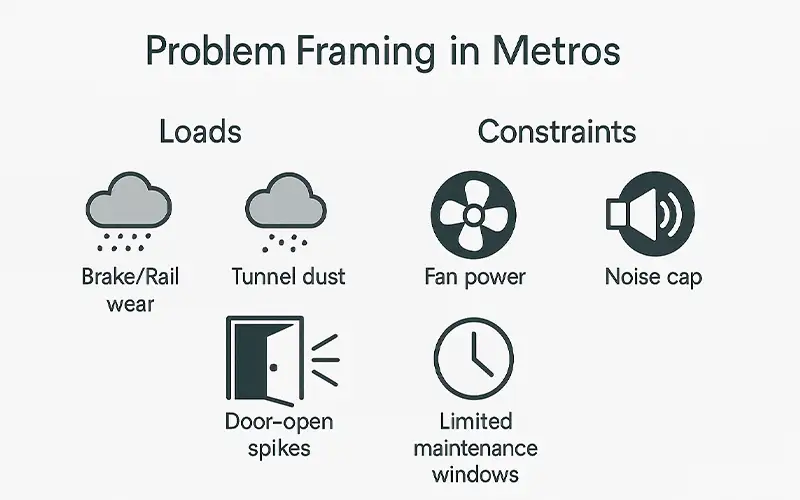
Underground systems face unique IAQ challenges: trains generate metal-rich dust at the wheel–rail–brake interface, tunnels accumulate fine particles, and stations see rapid occupancy swings.
A practical overview of sources and mitigation options is summarized in this public resource: Health Canada guidance on improving subway air quality.
Brake and rail wear drive PM1-heavy aerosols; tunnel dust and platform resuspension add PM2.5; door cycles pull in outdoor NO₂/O₃ and introduce VOCs and odors from equipment, cleaning, and passengers. Short, intense bursts occur at arrivals and during peak headways, stressing filters and ventilation.
Fan power and noise caps limit allowable pressure drop across filters, so media must deliver high capture at modest ΔP. Maintenance windows are short (overnights and turnbacks), favoring quick-swap cassettes and robust gaskets.
Any stack you spec should balance PM1 capture, gas/odor control, and changeout cadence without exceeding acoustic limits or energy budgets.
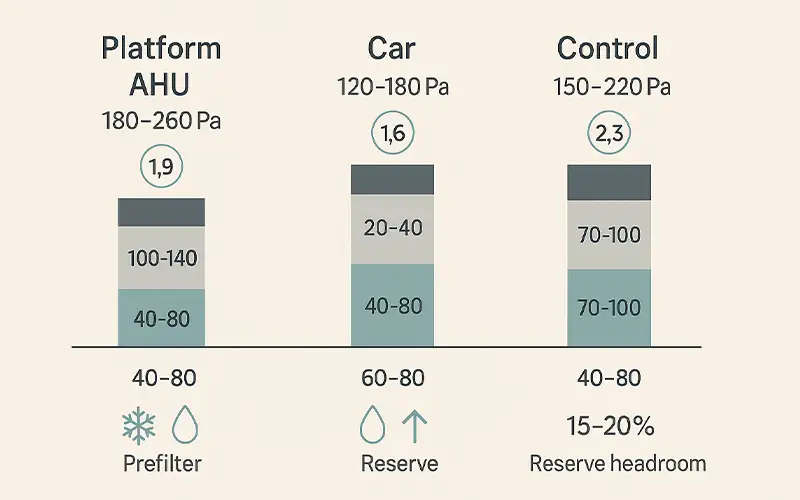
Start with a total ΔP target your fans can handle at design flow, then budget resistance across stages so no single layer starves the system. Typical starting points:
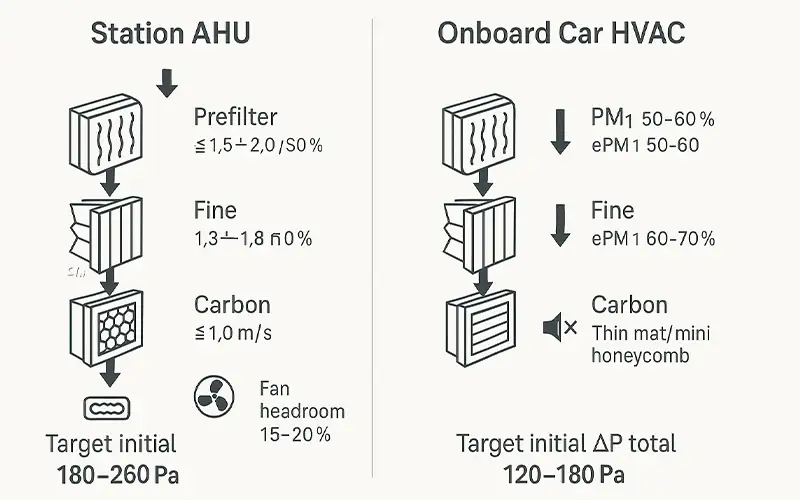
Platform AHU: total 180–260 Pa
ePM1 prefilter 40–80 Pa → fine filter 80–120 Pa → carbon 60–100 Pa
Onboard car HVAC: total 120–180 Pa
ePM1 prefilter 30–60 Pa → fine filter 60–90 Pa → carbon mat 20–40 Pa
Control/crew rooms: total 150–220 Pa
ePM1 prefilter 40–70 Pa → fine filter 80–110 Pa → optional carbon 30–60 Pa
For background on filtration and pressure-drop tradeoffs in HVAC, see the ASHRAE overview on filtration and air cleaning: ASHRAE technical resources.
Keep face velocities modest to stabilize ΔP and extend life:
Prefilter: 1.5–2.0 m/s
Fine filter (V-bank/cassette): 1.3–1.8 m/s
Carbon: size area for residence time first; aim ≤1.5 m/s through beds and ≤1.0 m/s through thin mats
Door-open spikes, headway compressions, and dusty events can add 10–25% transient load. Reserve 15–20% fan and ΔP headroom so the system can maintain flow without excessive noise.
When budgeting, ensure each stage can tolerate a 20–40 Pa rise before hitting the change threshold.
Cold-season frost: if intake air is cold and humid, keep prefilter ΔP low and avoid dense media first in line; consider preheat or bypass strategies to prevent icing.
High humidity and soot: prefer synthetic or hydrophobic media for the prefilter; protect carbon beds with a thin pre-screen to avoid wet fouling.
Condensation control: insulate frames/doors near cold surfaces and verify gasket compression to prevent edge bypass as temperatures swing.
Goal: strong PM1 reduction on platforms with practical energy and service cadence.
• Prefilter: ePM1 50–60% synthetic lofted or nanofiber pad/panel; initial ΔP 40–80 Pa; face velocity 1.5–2.0 m/s
• Fine filter: ePM1 70–80% V-bank or deep cassette for low resistance and long life; initial ΔP 80–120 Pa; face velocity 1.3–1.8 m/s
• Carbon layer: pellet or honeycomb module sized for gas targets (NO₂/O₃/VOCs)Carbon residence time
• Platforms with noticeable NO₂/O₃: 0.05–0.15 s superficial residence time through the bed at design flow
• VOC/odor-heavy stations: 0.15–0.30 s; consider staged beds or higher iodine number carbons
• Add a thin pre-screen (felt or mat) ahead of carbon to prevent dust fouling
• Use gasketed cassettes with perimeter compression and positive latches; avoid mixed media lots in the same bank
• Leave 15–20% spare fan headroom for door-open spikes; set change triggers at ΔP +40% over clean or spec max, plus odor breakthrough
• Where space allows, bias area toward the fine stage to slow loading; keep carbon modules in accessible pull-out frames for nightly swap if neededTypical stack example
• ePM1 55% prefilter → ePM1 75% V-bank fine → pellet carbon bed
• Total initial ΔP target: 180–260 Pa at design flow
Goal: good PM1 capture with tight noise and ΔP limits in a compact, vibration-prone package.
Vibration and acoustic constraints
• Use rigid cassette frames with anti-rattle features and continuous gasket compression
• Keep total initial ΔP in the 120–180 Pa range to protect fan noise margins
• Target face velocities ≤1.6 m/s through fine media; ≤1.0 m/s through thin carbon mats
• Prefilter: ePM1 50–60% low-resistance synthetic or nanofiber pad in a shallow cassette; initial ΔP 30–60 Pa
• Fine filter: ePM1 60–70% compact cassette; choose uniform pleat spacing and leak-tested seals; initial ΔP 60–90 Pa
• Carbon layer: thin mat or mini-honeycomb to polish odors/ozone with minimal ΔP (20–40 Pa typical)
• Use HEPA onboard only for special zones or medical-grade programs where validated PM removal is mandated and fans can support higher ΔP; verify enclosure sealing, leak testing, and acoustic impact
• Do not use HEPA where it forces fan upgrades, raises cabin noise, or shortens intervals unacceptably; instead, pair ePM1 70% fine media with an optimized recirc fraction and a thin carbon stage
• Change on ΔP +35–40% over clean or mileage/run-hours cap; add a secondary trigger from CO₂ or odor complaints on specific routes
• After service, quick sound check at cruise fan speed, gasket compression check, and a three-point particle spot test at typical passenger heightTypical stack example
• ePM1 55% prefilter → ePM1 65% compact fine → thin carbon mat
• Total initial ΔP target: 120–180 Pa at design flow
• Structure: multi-denier, depth-loading webs that spread dust through the thickness
• Strengths: low initial ΔP for the area; resilient under vibration; tolerant of humidity swings
• Watch-outs: gradual rise in ΔP; choose consistent loft to avoid patchy loading
• Structure: microfibrous base with nanofiber skin for higher capture at the same face velocity
• Strengths: strong PM1 efficiency at modest ΔP; good soot capture without rapid blinding
• Watch-outs: sensitive to oil/condensate fouling; specify surface energy and protective pre-screens in humid, sooty tunnels
• Structure: charged fibers that boost fine-particle capture at low resistance
• Strengths: excellent initial efficiency-per-Pa; useful for tight fan budgets
• Watch-outs: charge decay from high humidity, temperature, and oily aerosols; require periodic revalidation of performance
• High soot/humidity: favor synthetic or nanofiber with hydrophobic finish
• Tight ΔP budget: electret or nanofiber at lower basis weight
• Long life target: depth-loading synthetic with larger face area
• Typical metro targets: ePM1 60–80% for platforms and onboard supply
• Format: V-bank or deep cassette for low ΔP and long life; compact cassette for onboard space limits
• Use continuous perimeter gaskets and rigid frames; avoid mixed lots in the same bank
• Specify factory leak checks or onsite scan testing for critical zones
• Keep face velocity within the rated window to prevent pleat flutter and bypass
• Use HEPA for special areas with mandated PM removal or sensitive occupants, and only when fans and acoustics can support the higher ΔP and tighter seals
• Avoid HEPA if it forces fan upgrades, pushes cabin/platform noise over limits, or shortens intervals to impractical levels; instead, raise the fine stage to ePM1 80% and optimize recirculation and area
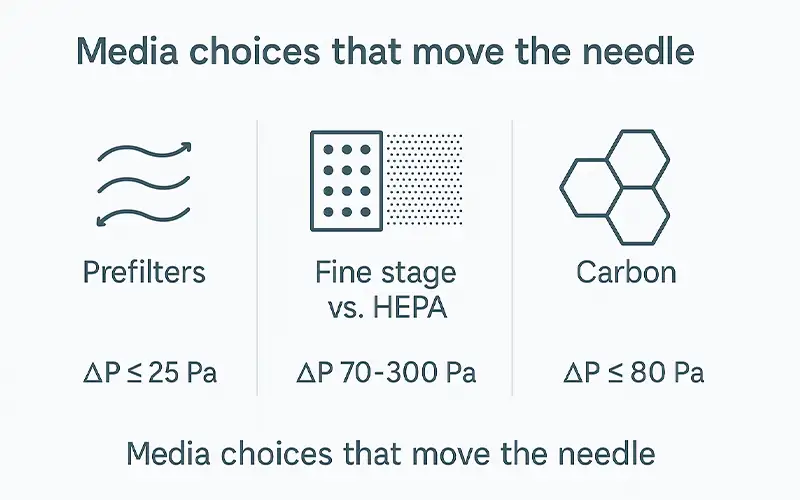
• Target initial ΔP 80–120 Pa for station V-banks, 60–90 Pa for onboard compact cassettes
• Keep velocities modest and add spare face area to absorb door-open spikes
• Strengths: highest residence time per module; strong NO₂/O₃ and VOC control
• Watch-outs: heavier and deeper; higher ΔP; need dust pre-screens and easy-access frames
• Strengths: structured channels provide good residence time with lower ΔP than pellet beds; durable and quick to swap
• Watch-outs: performance depends on channel geometry and loading; ensure gasketing to avoid bypass
• Strengths: thinnest and lowest ΔP; ideal for onboard polish of odors/ozone
• Watch-outs: limited residence time; breakthrough sooner on high gas loads
• Define gas targets (NO₂, O₃, VOCs) and set acceptance based on inlet concentrations and required removal; verify with periodic spot tests or badges
• Establish change triggers: odor complaints plus time-in-service or calculated breakthrough from known residence time and loading
Dust pre-screens
• Add a thin synthetic pre-screen ahead of carbon to trap soot and metal dust; prevents early fouling and preserves gas capacity
• Maintain pre-screen change cadence aligned with tunnel dust seasonality
Integration notes
• Budget ΔP for carbon early: 60–100 Pa for beds/blocks, 20–50 Pa for mats
• Keep modules close to access points for nightly or weekly swaps where needed
• Validate after install with odor checks and a few particle readings to ensure no new bypass paths were introduced
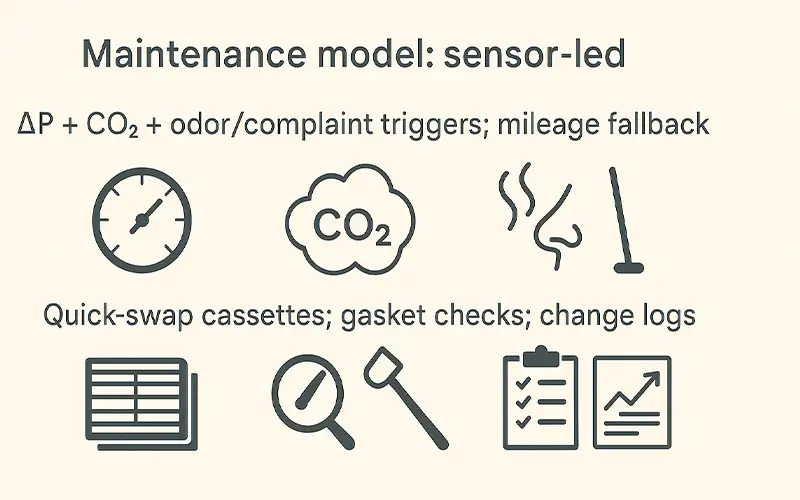
• Differential pressure: change when ΔP rises 35–40% over clean baseline or hits manufacturer max.
• CO₂: investigate at 1,000–1,200 ppm sustained on platforms or in cars; persistent spikes often indicate reduced airflow or clogged media.
• Odor/complaint signals: log ozone/solvent smells or passenger complaints; treat two or more events in a week as a service trigger.
• Mileage/run-hours fallback: set a cap based on duty cycle (for example, X km or Y hours since last change) to catch outliers.
• Use cassette formats with tool-less latches for fast changeouts in short windows.
• Remove pre-screens first, inspect for unusual fouling, then swap fine and carbon stages as needed.
• Keep spare, pre-gasketed cassettes staged trackside or in the service bay to minimize dwell time.
• Inspect perimeter gaskets for compression marks all around; no shiny gaps or lifted corners.
• Verify latch torque or clip tension; add compression clips where frames vibrate.
• Run a quick smoke pencil pass along seams to confirm no jetting or bypass after reassembly.
• Record date/time, location (station AHU, car ID), media grades/lots, ΔP in/out, CO₂ snapshot, and any odor notes.
• Track run-hours or mileage since last service and the number of passenger complaints.
• Review weekly for faster-than-normal ΔP rise, recurring odor spikes, or shortened intervals; adjust prefilter cadence or media grade accordingly.
• At operating setpoint, confirm ΔP returns to a reasonable clean value.
• Take three quick particle readings (PM1/PM2.5) or a CO₂ spot check at typical passenger height.
• Listen for airflow noise changes; excessive hiss often indicates high velocity or a leak path.
• Seasonally re-baseline clean ΔP and update the mileage/run-hours cap.
• Correlate IAQ metrics and complaints with weather, ridership, and construction events to refine change cycles.
• Standardize a one-page SOP and keep spare cassettes, gaskets, and pre-screens kitted for rapid response.
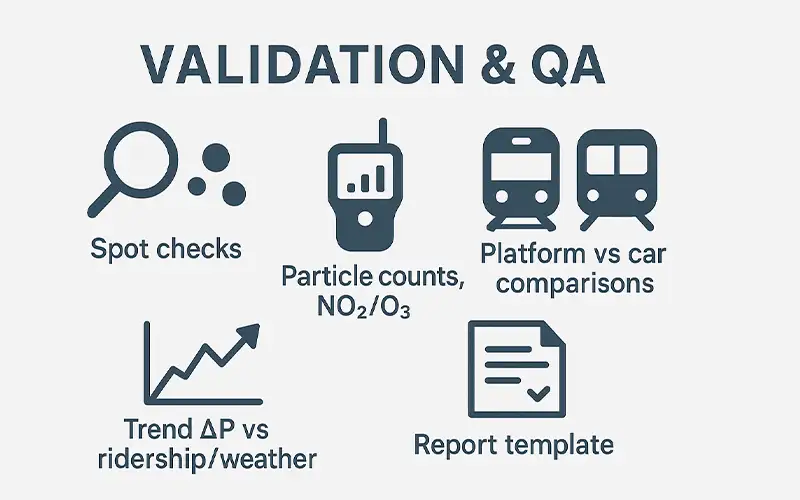
Take three-point spot readings for PM1 and PM2.5 at passenger height: platform centerline, near-door zone, and a quiet corner; onboard cars at mid-cabin, near doors, and HVAC return. Sample 60–120 seconds per point and log flow rate, time, and crowd level.
Use electrochemical badges or portable sensors for NO₂ and O₃; supplement with brief odor/sniff notes during peak and off-peak. Correlate spikes with train arrivals, door cycles, and tunnel airflow changes.
Pair measurements within 5–10 minutes to control for schedule effects. Flag gaps where platform air is clean but onboard counts are high (possible onboard recirc or sealing issue), or vice versa.
Trend daily average and peak differential pressure by filter stage against ridership counts or train-km. A rising ΔP at the same service level indicates loading faster than predicted; a flat ΔP with worsening IAQ suggests leaks or bypass.
Overlay temperature, humidity, wind direction, and known construction or track grinding events. Expect short-lived PM1/PM2.5 and NO₂ spikes during works; adjust prefilter cadence and spare capacity accordingly.
Set green/amber/red bands for PM1, PM2.5, and NO₂ based on your targets. Trigger investigation when two consecutive samples land in amber or any single red occurs.
• Date, line/station or car ID, service window, ambient conditions
• PM1/PM2.5 platform: center, door zone, corner (values, units, duration)
• PM1/PM2.5 onboard: mid-cabin, door zone, return grille
• NO₂/O₃ readings or badges, odor notes
• ΔP by stage: prefilter, fine, carbon; total system ΔP
• Ridership proxy: trains/hour or passenger counts; notable events
• Pass/fail against bands; anomalies and suspected causes
• Sealing issues, unusual noise, or velocity hotspots
• Immediate: reseat gasket, retape seam, swap prefilter/carbon
• Scheduled: adjust change interval, add spare face area, plan scan test
• Next check time, responsible technician, spare kits staged
• Spot checks weekly per line and after any filter change; full platform–car paired audit monthly
• Review trends in a standing 15-minute meeting; escalate persistent amber/red to maintenance planning with parts allocation and a timeline
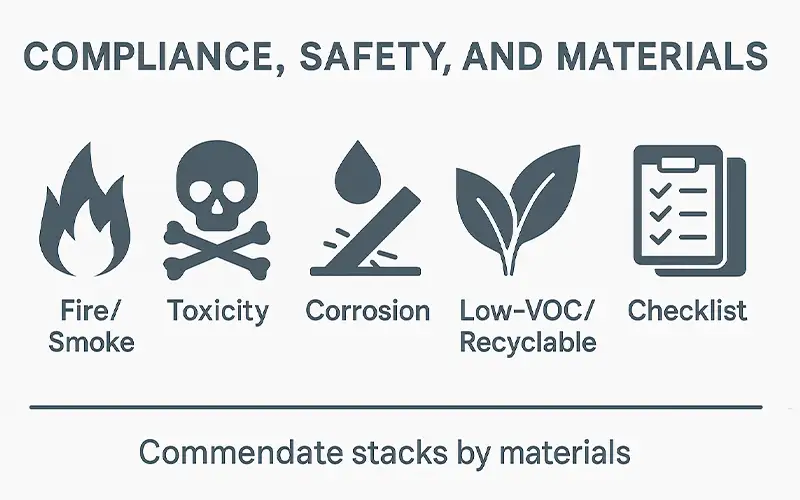
Specify filters, frames, and gasketing that meet the relevant rail and station fire-protection codes in your jurisdiction.
For metros, align with transit fire-safety standards for flame spread and smoke development, and require smoke density and dripping behavior tests for all polymer components. Where platforms share spaces with other occupancies, coordinate with the building code fire engineer to confirm acceptance.
For underground environments, prioritize low-toxicity materials. Require suppliers to disclose smoke-toxicity test results for plastics, adhesives, and media binders used in cassettes and seals.
Avoid halogenated additives where feasible; choose binders and foams with documented low toxic-gas release under fire.
Underground and coastal lines see humidity, salt, brake-dust metals, and cleaning chemicals. Specify corrosion-resistant frames and fasteners, with protective coatings where needed.
For carbon modules and fine filters, request verification of performance after humidity and salt-mist exposure. Tight gasketing and sealed seams help prevent condensate ingress and corrosion under seals.
Require a full materials dossier per filter type:
• Bill of materials with resin/binder families and any FR or anti-static additives
• Factory quality certificates and lot numbers printed on each cassette/module
• Test reports for airflow, ΔP, particle efficiency class, gas-removal capacity (if carbon), and relevant fire/smoke/chemical resistance tests
• Change-control policy: how the vendor notifies you of media or adhesive changes
Maintain a central log that ties installed lots to car IDs, station AHUs, dates, and measured clean ΔP for rapid recall or root-cause investigations.
Prefer low-VOC adhesives, sealants, and gasketing to reduce indoor emissions during service. Where possible, select media with solvent-free binders.
Choose designs that separate consumable media from reusable metal frames (or use metal-framed cassettes) to increase recyclability. For carbon, plan for safe end-of-life handling and explore reactivation programs where available.
• Materials: corrosion-resistant metals, low-toxicity polymers, solvent-free binders
• Safety: evidence of fire/smoke compliance and documented smoke-toxicity results
• Environment: humidity/salt/chemical exposure testing and anti-corrosion finishes
• Lifecycle: modular cassettes, recyclable frames, and published end-of-life guidance
• QA: lot-level traceability, test data, and change-notification commitments
• Confirm fire/smoke acceptance with the authority having jurisdiction before procurement
• Add smoke-toxicity and VOC clauses to purchase specs
• Include corrosion and humidity endurance in first-article qualification
• Enforce lot labeling and keep a digital register linking lots to installations
• Review sustainability: recyclable frames, low-VOC components, and carbon disposal/reactivation paths
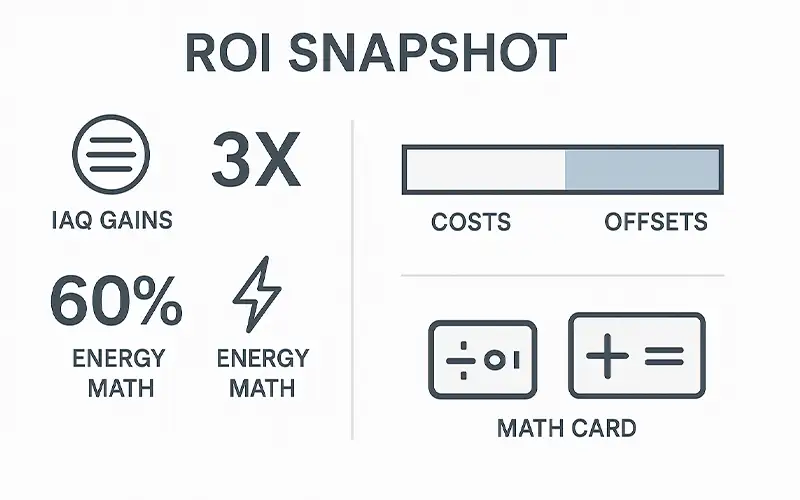
Upgrading the stack to ePM1-focused media with a right-sized carbon stage typically delivers:
• IAQ gains: lower PM1/PM2.5 on platforms and in cars, fewer odor/NO₂ spikes
• Quality-of-service gains: fewer complaints, better comfort at peak load
• Costs to watch: added pressure drop raising fan energy; filter spend and service timeThe ROI comes from balancing capture with resistance: use low-ΔP formats (V-bank/compact cassette), keep face velocity modest, and trigger changes on data (ΔP, CO₂, odor), not calendar alone.
• Design airflow: 25,000 m³/h
• Baseline total ΔP (old stack): 160 Pa
• Upgraded total ΔP (new stack): 210 Pa
• Fan–wire efficiency: 55%
• Operating hours: 6,000 h/year
• Electricity: $0.12/kWh
• ΔP increase: 50 Pa
• Flow in m³/s: 25,000 ÷ 3,600 = 6.94 m³/s
• Air power increase: 50 × 6.94 = 347 W
• Shaft/motor power: 347 ÷ 0.55 ≈ 631 W
• 0.631 kW × 6,000 h = 3,786 kWh/year
• Energy cost ≈ $454/year
• Prefilter upgrade extends fine filter life by 30%: two instead of three fine-filter changes per year
• Labor saved: 1 change × 1.5 h × $75/h = $112
• Parts saved: one fine-filter set = $420
• Complaint reduction and odor control: fewer off-hours callouts, say 2 events avoided × $150 = $300
Total estimated offsets ≈ $832/year
• Added fan energy: $454
• Offsets (life + labor + avoided callouts): $832
• Net operating savings: ≈ $378/year per AHU
• Plus IAQ benefit: PM1 reduction, fewer odor/NO₂ spikes, improved passenger experience
• Budget ΔP by stage and add area where it buys the most life (usually the fine stage).
• Use carbon only to the level needed by measured NO₂/O₃/VOC loads; avoid over-sizing.
• Keep prefilters fresh to protect downstream stages and sustain low ΔP.
• Validate change triggers with short weekly spot checks and ΔP trendlines.
If an upgrade raises annual fan energy by X dollars, target at least 1.5–3.0× X in combined savings from longer filter life, faster changeouts, and fewer IAQ-related events.
If the ratio is lower, revisit media grade, face area, or carbon residence time.


Leave a comment