Skip to content
Capturing Metal Dust at the Source: Local Filtration Explained

Capturing Metal Dust at the Source: Local Filtration Explained

Metal fabrication generates fine, respirable dust at the tool face—long before ambient systems can dilute it. Source-capture filtration intercepts particles the moment they’re created, reducing worker exposure, protecting equipment, and cutting cleanup and downtime. This post explains why local exhaust beats general ventilation and how to design a right-sized system for grinding, cutting, welding, and polishing.

The hidden danger of metal dust in fabrication shops

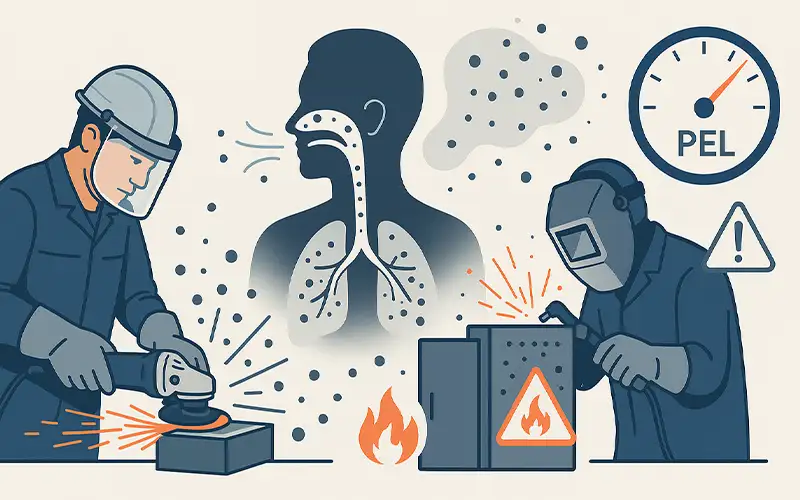
Metal fabrication generates respirable dust at the tool face—during grinding, cutting, polishing, and welding—long before ambient systems can dilute it. Fine particles under 5 µm remain suspended for long periods, drift across work zones, and deposit inside machines and electrical cabinets, raising both health and equipment risks.

Common sources in daily operations

Grinding wheels, abrasive belts, saws, and polishers shed metallic fines; welding and cutting create fume that agglomerates into ultrafine and fine particulates; oily residues from metalworking fluids can aerosolize and carry metals throughout the shop.

Health and safety implications

Chronic exposure to metal particulate and metalworking-fluid aerosols is associated with respiratory irritation, asthma, and other lung effects; certain welding fumes add additional systemic risks. Facilities must also address combustible dust hazards—finely divided metals (e.g., aluminum) that are not flammable in bulk can become explosible as dust clouds. See OSHA’s overview on combustible dust hazards and controls: OSHA combustible dust.

Exposure limits and guidance (OSHA/NIOSH/ACGIH context)

Shops typically benchmark exposures against OSHA Permissible Exposure Limits (PELs) and use authoritative references to look up element-specific limits (e.g., manganese, chromium, nickel). A practical starting point is the NIOSH Pocket Guide, which lists recommended exposure limits (RELs) and key health data for hundreds of metals and compounds: NIOSH Pocket Guide.

Why this matters for filtration design

Because the smallest, most mobile particles travel farthest, the highest return on control typically comes from source capture at emission points, backed by staged filtration and routine differential-pressure monitoring to prevent re-entrainment and explosion-prone accumulations.

Why source capture is more effective than general ventilation

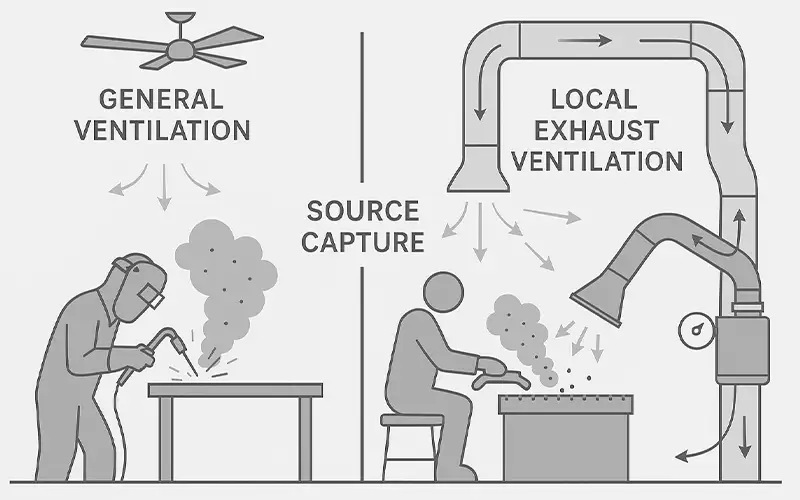
Relying on general or ambient ventilation to manage airborne metal dust is rarely enough. Once particles disperse into the shop air, they mix with heat, humidity, and oil mist, making them harder to collect and more likely to be inhaled or settle inside sensitive equipment.

Source capture systems prevent this by intercepting dust and fume at the point of generation—before it spreads beyond the work zone.

The limits of ambient air cleaning and dilution methods

Ambient air cleaners and roof-mounted exhaust systems work well for comfort ventilation but cannot protect workers close to the emission source.

Dilution relies on air exchange, not removal, which means fine particles (<5 µm) can remain airborne for hours.

Studies referenced by the U.S. Occupational Safety and Health Administration (OSHA) note that even low airborne concentrations of respirable metal dust can exceed permissible exposure limits near grinding and welding stations.

For OSHA guidance, see OSHA ventilation and fume control.

How local exhaust or source capture systems work

Local exhaust ventilation (LEV) removes contaminants directly at the emission point through hoods, ducts, and filters. Capture efficiency depends on maintaining adequate face velocity to draw the dust plume before it escapes the tool area.

This method sharply reduces worker exposure, limits re-deposition on surfaces, and protects downstream HVAC components from clogging. The National Institute for Occupational Safety and Health (NIOSH) offers detailed design guidance for LEV systems in its Industrial Ventilation manual.

Practical examples of source capture

Common applications include welding hoods positioned near the arc, downdraft benches used for grinding or sanding, and articulated capture arms for mobile stations.

These systems localize the airflow, contain sparks, and feed captured dust through high-efficiency filters before safe discharge or recirculation.

Role of filter placement and airflow velocity

The performance of any capture system depends on balanced airflow and filter positioning. Filters should be located close enough to minimize duct losses but far enough to prevent spark ignition or oil loading.

Properly sized ducts, smooth bends, and consistent velocity (typically 18–20 m/s for metallic dust) ensure stable suction without re-entrainment.

Periodic airflow testing and ΔP monitoring confirm that the system continues operating within design specifications—keeping fine metal particulates under control and within regulatory limits.

Key components of an effective local filtration system

A well-designed source-capture system removes metal dust at the tool face and keeps it from migrating across work zones.

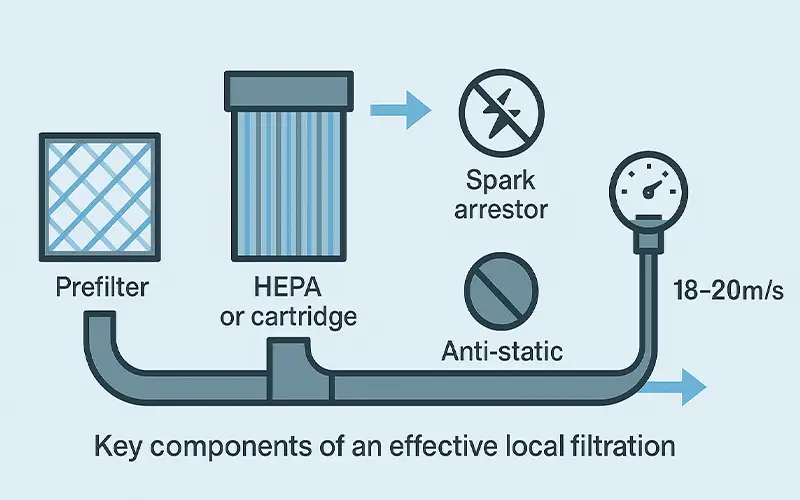
The following components work together to maintain capture efficiency, protect equipment, and reduce exposure.

Prefilter: traps larger grinding debris and oil mist

Use a high-capacity prefilter stage (coarse pad, pleated panel, or coalescing media) to catch sparks, swarf, and oil aerosols before they load the final filter.

Coalescing prefilters condense mist into drainable droplets, cutting pressure rise and extending downstream filter life. Change prefilters based on differential pressure trends rather than fixed intervals.

HEPA or cartridge filters: capture fine respirable metal dust

For fine and respirable particulates, select either HEPA modules (for very high efficiency and recirculation) or high-efficiency cartridge filters with nanofiber media (for pulse-cleaned collectors).

Match media to the contaminant: oleophobic or PTFE membranes for oily dusts, abrasion-resistant blends for heavy grinding. Size the filtration area to keep air-to-cloth ratios within the collector’s specification and to maintain stable airflow under load.

Spark arrestors and anti-static media for combustible dust applications

Before any fine filter stage, add an inline spark arrestor or drop-out chamber to cool and separate hot particles. In applications involving aluminum, magnesium, or titanium, specify conductive (anti-static) cartridges and properly bond/ground all components to prevent charge buildup. Locate ignition sources away from filter media and consider isolation valves where required.

Ducting and airflow balancing to prevent pressure loss or re-entrainment

Design short, direct duct runs with smooth-radius elbows and sealed joints to minimize static pressure. Maintain transport velocities around 18–20 m/s (≈3500–4000 fpm) for metallic dust to prevent settling.

Balance branches so each hood meets its capture velocity, then verify with airflow measurements and differential pressure monitoring. Proper balancing preserves capture at the source and prevents dust from re-entering the workspace.

Maintenance and monitoring for consistent performance

Keeping a local filtration system within design specs requires disciplined inspections, data-driven changeouts, and post-maintenance verification.

The goal is stable capture at the source with minimal pressure loss and no contaminant re-entrainment.

Importance of regular filter change and ΔP monitoring

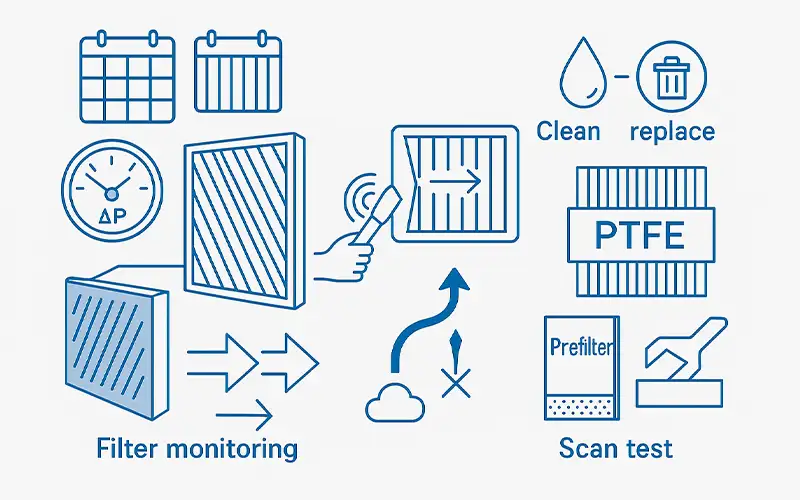
Track differential pressure (ΔP) across each stage—prefilter, fine filter, and final—to detect loading trends early. Establish alarm bands (e.g., baseline ±10% watch, ±20% action) and log ΔP alongside airflow readings after startup, weekly, and after any process change.

Replace prefilters before they drive excessive ΔP; this protects HEPA/cartridge stages, stabilizes fan curves, and maintains capture velocity at hoods. After any changeout, leak/scan test finals, verify gasket compression, and recheck hood velocities to confirm the system has returned to its validated state.

Cleaning vs. replacement cycles for cartridge-type filters

For dry, non-oily dusts, pulse-cleaned cartridges can be restored repeatedly until end-of-life criteria are met: rising residual ΔP after cleaning, damaged pleats, pinholes, or loss of efficiency.

For oily or hygroscopic dusts, cleaning is less effective—consider oleophobic/PTFE media, upstream coalescers, or planned replacement cycles.

Keep air-to-cloth ratios within the collector’s specification, maintain proper compressed-air quality for pulsing, and document the number of cleaning cycles to predict service life.

How poor maintenance leads to backflow and re-contamination

Overloaded or damaged filters increase system resistance, reducing capture velocity and allowing dust to escape the hood. Bypass from bad seals or warped frames carries fines downstream, while full hoppers and bridging push dust back into the airstream during fan transients.

Unbalanced ducts cause settling and later re-entrainment. The result is backflow into work zones, fouled equipment, and potential combustible-dust accumulations.

Prevent this with timely prefilter changes, seal inspections, hopper level checks, ΔP/airflow trending, and periodic rebalancing of branches.

CleanLink solutions for metal processing environments

CleanLink designs source-capture and filtration systems that control metal dust and fumes at the point of generation, stabilizing air quality, protecting equipment, and helping plants meet exposure and safety targets without sacrificing throughput.

Source-capture filter modules for cutting, grinding, and polishing zones

Deploy localized hoods, downdraft benches, and articulated capture arms paired with high-capacity collectors to intercept particulate before it disperses. Our modules are sized for typical tool face velocities and airflows in abrasive operations, with configurable inlets, silencers, and quick-change filter access to minimize downtime.

High-temperature filter media for heavy-duty lines

Select synthetic or glass-fiber blends engineered for elevated temperatures and mist-laden streams. Oleophobic and PTFE membrane options shed oil and fine aerosols, keeping pressure drop stable and extending service intervals on lines that combine cutting fluids with high heat, such as sawing, forging prep, or hot grinding.

Optional HEPA upgrades and spark protection for aluminum or titanium dust

When fine respirable particulates or recirculation require higher efficiency, add terminal HEPA stages for submicron capture. For combustible metal applications, integrate inline spark arrestors, drop-out chambers, and anti-static cartridges, with proper bonding and grounding to mitigate ignition and reduce explosion risk.

Custom integration with ducted and standalone local exhaust systems

CleanLink systems tie into existing ductwork or operate as standalone units where mobility or floor space is a constraint.

We balance branches to maintain capture velocity at each hood, specify transport velocities to prevent settling, and instrument collectors with differential pressure and airflow monitoring so maintenance can be planned on condition, not guesswork.

The result is a right-sized, serviceable system that keeps dust out of breathing zones and off critical equipment.

Cleaner air, Safer work, Stronger ROI

Source-capture filtration removes metal dust at the tool face, cutting worker exposure, reducing combustible-dust risk, and keeping fines out of machines and cabinets. Cleaner air means steadier tolerances, less rework, and simpler housekeeping.

Operational and health benefits

  • Captures respirable and ultrafine particles where they form.

  • Staged media keeps pressure drop stable and airflow consistent.

  • Less contamination on equipment extends service life.

Energy, compliance, productivity

  • Low-ΔP designs and balanced ducts lower fan energy.

  • Easier compliance with OSHA/ACGIH targets and dust-hazard best practices.

  • Fewer stoppages and cleaner lines raise throughput.

Plan early

Integrate source capture in cell layout, hood geometry, and duct routing during project planning. Specify transport velocity, ΔP monitoring, and service clearances up front to commission faster and preserve long-term performance.

Need Help Choosing the Right Air Filters for Your Facilities?

Selecting the right air filters for your facilities can be a challenging task, given the variety of filter types and specifications available. If you're unsure about which filter best suits your needs, our team of experts is here to help.

With years of experience in air filtration solutions, we can guide you in choosing the ideal filter to optimize your application's performance and ensure superior air quality.

Contact us today for personalized advice and assistance tailored to your specific requirements.

Previous article How Air Filtration Safeguards Product Sterility in Pharma Cleanrooms
Next article Choosing media for metros: ePM1 prefilters, fine filters, and carbon layers

Leave a comment

* Required fields