Skip to content
Why Air Filtration Matters in Cold Chain Food Transportation

Why Air Filtration Matters in Cold Chain Food Transportation

Cold chain logistics depends on one promise: perishable food must travel in a controlled environment to stay safe, fresh, and market-ready. While temperature control is the first priority, the air quality inside refrigerated trucks and containers plays an equally important role. Every hour of transport exposes meat, dairy, seafood, produce, and ready-to-eat items to the surrounding air—and if that air contains dust, spores, or strong odors, product quality can decline even when temperatures remain within range.

Airborne contaminants enter reefer units through loading docks, door openings, packaging debris, and residues from previous loads. Moisture and organic particles can keep spores and microbes suspended, increasing the risk of spoilage or odor transfer during long routes.

This is why air filtration is a core part of cold chain integrity, not a minor accessory. By removing particles, microbes, and odors from recirculated air, proper filtration creates a cleaner, more stable environment for transported foods—supporting longer shelf life, fewer delivery complaints, and stronger compliance with food safety standards.

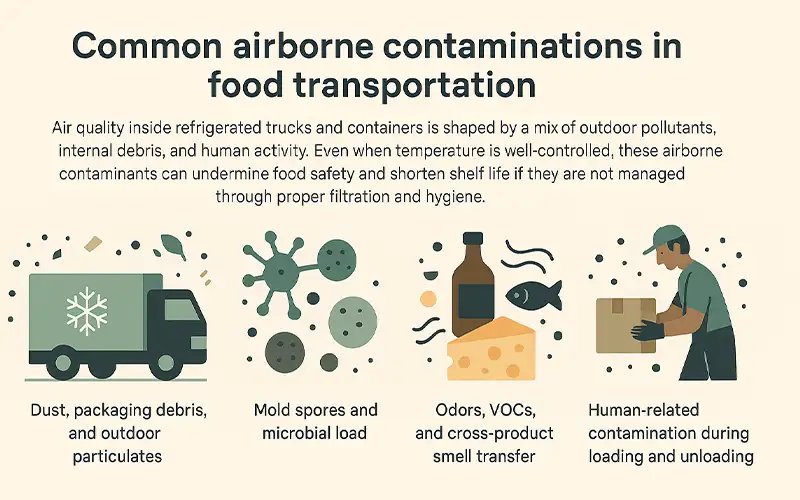
Common airborne contaminants in food transportation

Air quality inside refrigerated trucks and containers is shaped by a mix of outdoor pollutants, internal debris, and human activity.

Even when temperature is well-controlled, these airborne contaminants can undermine food safety and shorten shelf life if they are not managed through proper filtration and hygiene.

Dust, packaging debris, and outdoor particulates

Every loading dock, cross-dock hub, and roadside stop introduces new particles into the air. Forklifts, pallets, and cardboard shed dust and fibers, while open doors allow in road dust and exhaust particles. Over time, this mixture settles on packaging surfaces and may reach food if outer barriers are compromised. Guidance on sanitary food transport emphasizes the need to protect food from unsanitary conditions and prevent contamination during loading, holding, and transit, as highlighted in the FDA’s sanitary transportation rule.

Mold spores and microbial load

Mold spores and other microorganisms can enter vehicles from the environment, from previous loads, or from damp interior surfaces.

Once inside, they can remain airborne or settle on cold, moist surfaces where they may slowly grow, especially if condensation or organic residues are present.

Reviews of airborne contamination in the food industry show that bioaerosols containing mold, yeast, and bacteria can negatively affect product shelf life and safety when not controlled by filtration and hygiene practices. 

Odors, VOCs, and cross-product smell transfer

Odors and volatile organic compounds (VOCs) arise from a range of sources: cleaning chemicals, fuel residues, packaging materials, and the foods themselves.

In mixed loads, strong-smelling products such as seafood, spices, or certain cheeses can transfer odors to more neutral items, damaging brand perception even if safety is not directly compromised.

VOCs from plastics and cleaners can also build up in poorly ventilated spaces, an issue increasingly recognized in supply chain environments. 

Human-related contamination during loading and unloading

People are another major source of airborne contamination. Clothing fibers, skin flakes, respiratory droplets, and handling practices all contribute to the overall microbial and particulate load inside vehicles.

International guidance on transport hygiene stresses that food can be contaminated or damaged during transport if vehicles and handling practices are not properly managed, reinforcing the need for integrated hygiene, training, and air quality controls.

The FAO’s guidance on transportation hygiene highlights how poor transport conditions can compromise food safety even when earlier steps in the chain were well controlled. 

By understanding these airborne contaminant sources, cold chain operators can design filtration and hygiene strategies that actively protect food quality—not just maintain temperature readings.

Why Air Filtration Matters in Cold Chain Food Transportation

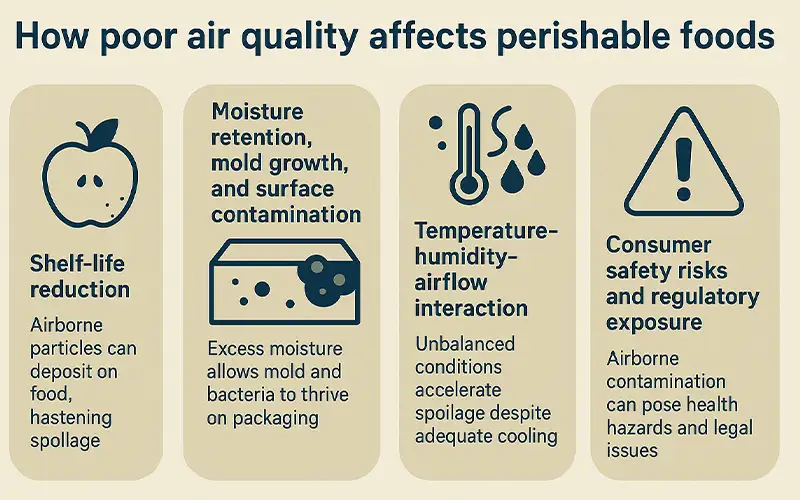
How poor air quality affects perishable foods

Air quality inside refrigerated trucks and containers directly shapes food freshness, appearance, and safety. Even when temperature targets are met, airborne contaminants, moisture imbalance, and unstable airflow can accelerate spoilage or cause regulatory issues.

Understanding these mechanisms helps operators strengthen cold chain integrity beyond temperature control alone.

Shelf-life reduction

Airborne particles—such as dust, fibers, and microbial aerosols—can settle on packaging surfaces or, in some cases, reach exposed foods. These contaminants create micro-environments that promote oxidation, discoloration, or microbial activity.

Poor air quality also increases the overall biological load inside the trailer, pushing perishable products closer to their spoilage threshold.

According to the FDA’s guidance on sanitary transportation (Sanitary Transportation Rule), maintaining clean conditions during transit is essential to preventing food from becoming unsafe or compromised.

Moisture retention, mold growth, and surface contamination

Cold environments naturally promote condensation. When moisture combines with mold spores or bacteria already suspended in the air, it becomes easier for microbes to settle and multiply on food packaging—especially cardboard or absorbent materials.

Excess humidity can also make produce degrade faster and cause surface stickiness or softening. Research summarized in the FAO’s hygiene guidelines for food transport (FAO transportation hygiene) notes that moisture and poor ventilation significantly increase microbial activity during transit, even in refrigerated settings.

Temperature–humidity–airflow interaction

Temperature alone does not determine cold chain stability. If airflow is uneven or if filters are clogged, cold air may not circulate properly, leading to “hot spots” where food warms slightly or absorbs moisture.

Poor airflow also prevents contaminants from being captured by the filtration system, allowing them to recirculate. The result is a dynamic where temperature, humidity, and airborne particles amplify each other—accelerating spoilage despite technically acceptable reefer temperatures.

Consumer safety risks and regulatory exposure

Airborne contamination can create safety hazards such as pathogen transfer, allergen cross-contact, or chemical odor absorption.

If food becomes unsafe or contaminated during transport, the carrier can face liability under food safety laws. Regulatory frameworks emphasize that refrigerated transport must prevent contamination in addition to maintaining temperature, a point reinforced in the FDA’s sanitary transport requirements.

Failure to control air quality can lead to rejected loads, recalls, or non-compliance with retailer specifications.

By actively managing air filtration, airflow balance, and humidity, cold chain operators can protect both product quality and regulatory compliance—not just temperature records.

Why Air Filtration Matters in Cold Chain Food Transportation

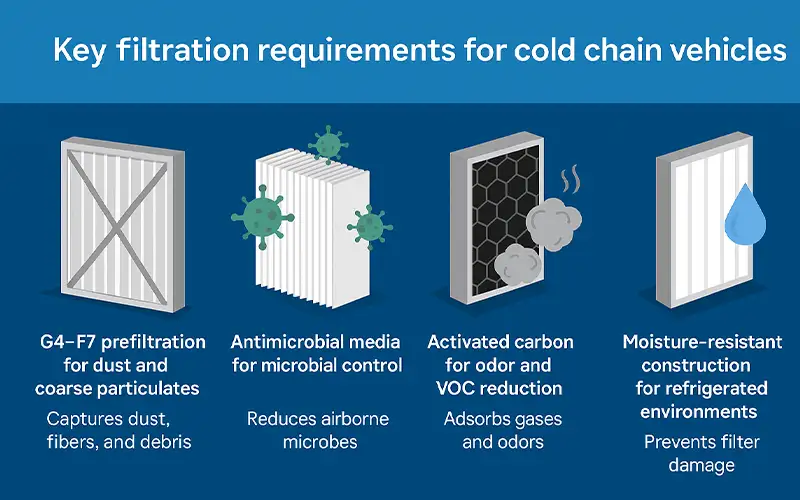
Key filtration requirements for cold chain vehicles

Air filtration in refrigerated trucks and containers must address more than basic dust removal. Cold chain environments face unique challenges—low temperatures, high humidity swings, frequent door openings, and mixed-product loads.

To maintain food quality and reduce contamination risks, filtration systems must combine particle removal, microbial control, odor management, and structural durability.

G4–F7 prefiltration for dust and coarse particulates

Cold chain vehicles frequently load and unload in busy distribution centers where dust, packaging fibers, and outdoor particulates easily enter the air stream.

G4–F7 prefilters provide the first line of defense by capturing coarse dust, cardboard fibers, pallet debris, and other visible contaminants.

This prevents heavier particles from circulating within the trailer and reduces buildup on coils and evaporators, helping the refrigeration unit maintain consistent airflow and cooling efficiency. Prefiltration also protects downstream antimicrobial or carbon layers, extending their service life.

Antimicrobial media for microbial control

Microbial aerosols—such as mold spores, yeast, and bacteria—pose a significant risk to perishable foods, especially in humid or high-moisture cargo environments.

Filters that use antimicrobial-treated media can inhibit microbial growth on the filter surface and reduce microbial load in the circulating air.

This is particularly important for meat, dairy, seafood, and ready-to-eat foods that are sensitive to surface contamination.

Antimicrobial media helps address both safety and shelf-life concerns by lowering the concentration of airborne microbes that could settle on packaging or equipment.

Activated carbon for odor and VOC reduction

Mixed loads often include foods with strong odors—such as seafood, spices, fruits, or cheeses—that can transfer smell to other products during long-distance transport.

Refrigerated compartments may also contain VOCs from cleaning chemicals, fuel residues, or packaging materials. Activated carbon filters help adsorb these gases and prevent odor migration across product categories.

For fleets transporting high-value or odor-sensitive items, carbon filtration is essential to preserving product integrity and customer satisfaction.

Moisture-resistant construction for refrigerated environments

Refrigerated trucks and containers operate in cold, humid conditions where condensation is common.

Filters must be built with moisture-resistant frames, hydrophobic fibers, and corrosion-resistant materials to prevent warping, microbial growth, or structural collapse.

Filters not designed for cold chain environments can absorb moisture, freeze, or deform—leading to air bypass and reduced filtration performance.

Moisture-resistant construction ensures the filter maintains its shape, efficiency, and sealing integrity throughout the route, even under repeated temperature and humidity shifts.

By combining prefiltration, antimicrobial protection, gas-phase adsorption, and moisture-resistant construction, cold chain operators can build a filtration system capable of supporting food safety, preserving freshness, and maintaining stable air conditions inside refrigerated vehicles.
Why Air Filtration Matters in Cold Chain Food Transportation

HVAC & airflow dynamics in refrigerated trucks and containers

Airflow inside a refrigerated truck or container is one of the most important—but often overlooked—factors in cold chain performance. Even with the right filter and correct temperature settings, poor air movement can lead to warm spots, condensation, and uneven product cooling.

Understanding how reefer units circulate air, and how contamination enters and escapes the system, helps operators maintain both food safety and equipment efficiency.

How reefer units circulate cooled, filtered air

Refrigerated trucks and containers (reefers) operate on a continuous circulation loop. The reefer unit pulls warm air from the cargo space, passes it over the evaporator coil to cool it, pushes it through the filtration stage, and then redistributes the cooled, filtered air evenly through the trailer.
A consistent airflow pattern is essential because:

  • food must cool uniformly

  • airborne contaminants must stay in motion to be captured by the filter

  • moisture must not accumulate in dead spots
    If airflow becomes blocked by overloaded pallets or collapsed filters, temperature uniformity suffers, and the risk of spoilage and microbial growth increases. Proper loading patterns and well-maintained filtration systems help keep airflow stable from front to back.

Door openings and contamination spikes

Every time a trailer door opens—especially during multi-stop routes—new contaminants enter the environment. Outdoor PM, road dust, pollen, exhaust particles, and humidity rush into the cargo space.

Warm, moist air condenses quickly on cold surfaces, creating ideal conditions for mold spores or bacteria to settle.
Contamination spikes are most severe when:

  • doors are opened for extended periods

  • loading docks lack proper ventilation

  • seafood, produce, meat, and dairy are loaded in mixed environments
    High-quality prefiltration and antimicrobial media help reduce the impact of these spikes by capturing contaminants as the reefer unit recirculates the air after doors close.

Air bypass risks from poorly sealed filters

Even the best filter cannot protect a load if air bypasses it. In reefers, vibration, moisture, and pressure fluctuations can loosen poorly installed or low-quality filters. When gaps form around the frame or gasket, unfiltered air moves directly into the cargo space, carrying dust, spores, or odors with it.
Common causes of bypass include:

  • warped or moisture-damaged filter frames

  • filters not designed for cold, humid environments

  • loose housings from vibration and long transport hours

  • clogged filters causing pressure imbalances

Well-sealed, moisture-resistant filters—especially those with rigid frames and high-integrity gaskets—ensure that all circulating air passes through the filtration media, not around it. For high-value perishable shipments, maintaining sealing integrity is just as important as the filter efficiency itself.

By understanding airflow dynamics and minimizing bypass and contamination spikes, cold chain fleets can maintain safer, cleaner, and more stable transport environments that protect product quality from loading dock to final delivery.

Benefits of high-performance filters in cold chain transport

High-performance air filtration plays an essential role in protecting perishable foods throughout the cold chain. In refrigerated trucks, containers, and last-mile delivery vehicles, advanced filters help stabilize environmental conditions, reduce contamination risks, and support consistent product quality.

Using stronger, specialized filters allows fleets to maintain food safety while improving operational efficiency and reducing energy waste.

Reduced microbial load and spoilage

Cold temperatures slow microbial growth, but they do not eliminate airborne contamination. Mold spores, bacteria, and yeast can circulate inside reefer units—especially after loading or during frequent door openings.

High-performance filters with antimicrobial media significantly reduce the number of viable particles in the air stream, helping to slow surface contamination on produce, meat, dairy, or ready-to-eat items. Lower microbial load directly contributes to:

  • longer shelf life

  • fewer rejected shipments

  • reduced risk of cross-contamination
    This is especially valuable for mixed loads and long-haul routes where environmental control must remain stable for extended periods.

More stable temperature and humidity control

Airflow uniformity is critical in cold chain logistics. When filters clog or airflow weakens, temperature stratification and moisture buildup become more likely.

High-performance, low-resistance filters keep the air moving efficiently, allowing the reefer unit to:

  • maintain target temperatures across the entire cargo space

  • prevent warm pockets where spoilage accelerates

  • avoid condensation that encourages mold
    Stable airflow also reduces the load on the evaporator coil, helping it operate more consistently throughout the journey.

Lower odor transfer between food categories

Odor contamination is a major concern in mixed-food shipments. Fish, dairy, produce, and processed foods can all emit natural VOCs that migrate through unfiltered or poorly filtered air.

Filters equipped with activated carbon or blended gas-phase media help adsorb these odor-causing molecules. The result is:

  • less cross-smell transfer

  • fewer customer complaints

  • improved product presentation upon delivery
    Odor control is particularly important for multi-pick and multi-drop deliveries where product categories frequently change.

Improved energy efficiency with low-ΔP media

Energy consumption is one of the largest operational costs for refrigerated fleets. When filters become highly restrictive, fans must work harder to maintain airflow, increasing fuel or electricity use.

High-performance filters designed with low-ΔP media maintain filtration efficiency while minimizing resistance. This delivers multiple advantages:

  • lower energy consumption per trip

  • reduced compressor runtime

  • less strain on motors, belts, and fans

  • longer reefer equipment lifespan

Over time, fleets benefit from both improved load protection and lower operating costs—a combination that strengthens profitability and service reliability across the cold chain.

Maintenance & best practices

Proper maintenance is essential for ensuring that air filtration systems in cold chain vehicles continue performing reliably. Refrigerated trucks and containers operate under high moisture, fluctuating temperatures, and continuous airflow demands.

Without a structured maintenance plan, even high-quality filters can lose effectiveness, allowing contaminants to circulate and threatening product integrity. The following best practices help fleets maintain consistent air quality and extend equipment life.

Replacement intervals in cold environments

Cold environments slow microbial growth but increase moisture exposure, which can shorten filter life if media becomes damp or overloaded. Refrigerated units also tend to accumulate fine particulates from roads, warehouses, and packaging debris.
General recommendations include:

  • replacing G4–F7 prefilters every 1–3 months depending on route conditions

  • replacing antimicrobial or carbon-enhanced filters according to manufacturer specs (typically every 3–6 months)

  • increasing replacement frequency during peak seasons such as summer produce logistics
    Operators should adjust intervals based on cargo type, mileage, and environmental load. Loads with fresh produce, dairy, meat, or seafood typically require more frequent inspections to prevent exposure to odors and bioaerosols.

Monitoring differential pressure in reefer units

Differential pressure (ΔP) is one of the most important indicators of filter condition in cold chain vehicles. As filters load with dust, organic particles, and moisture, airflow resistance increases.
Monitoring ΔP helps operators:

  • detect when filters are overloaded

  • prevent reduced airflow that causes temperature spikes

  • avoid excessive strain on reefer fans and compressors

  • maintain stable humidity and minimize condensation on cargo
    Fleet managers can integrate ΔP monitoring into telematics systems to track performance across multiple vehicles and trigger alerts when thresholds are exceeded.

Cleaning coils and ducts to prevent contamination buildup

Air filters are only one part of the contamination control system. Evaporator coils, drip pans, and ducts inside reefer units can accumulate dust, organic residue, and biofilm—especially when filters are overdue for replacement. Dirty coils reduce cooling efficiency and create potential points of microbial growth.
Best practices include:

  • regular coil cleaning using food-safe cleaners

  • inspecting drain lines to ensure moisture exits properly

  • brushing or vacuuming duct surfaces to prevent dust recirculation

  • sanitizing interior panels during routine deep-clean cycles
    Proper coil and duct maintenance supports filtration performance, reduces odor issues, and keeps reefer units operating within designed efficiency ranges.

With consistent maintenance—filter replacement, ΔP monitoring, and system cleaning—cold chain fleets maintain safer conditions for food cargo, reduce waste, and support higher operational reliability throughout the transportation cycle.

Clean-Link solutions for food transportation fleets

Cold chain logistics require filtration systems that can operate reliably under low temperatures, high humidity, and constant vibration. Clean-Link provides engineered filtration solutions designed to maintain air quality inside refrigerated trucks and containers, helping fleet operators protect perishable products, reduce contamination risks, and maintain regulatory compliance.

Prefilters, antimicrobial media, and carbon filtration

Clean-Link offers a multi-stage filtration lineup tailored to the needs of food transportation:
G4–F7 prefilters capture dust, packaging debris, and coarse particulates that enter during loading and unloading. By blocking these larger contaminants, prefilters extend the service life of reefer coils and downstream filters.

Antimicrobial media help control microbial load within the airflow of refrigerated units. These filters inhibit the growth of mold and bacteria—especially important when transporting fresh produce, meat, seafood, and dairy, where microbial contamination can lead to spoilage or shortened shelf life.

Activated carbon filters address odors and volatile organic compounds (VOCs). They prevent unwanted smell transfer between mixed loads and help maintain a neutral environment inside the cargo space, which improves product quality and customer perception.

OEM custom sizes for refrigerated trucks and containers

Refrigerated transport equipment varies widely across fleets, with many units using non-standard filter dimensions. Clean-Link provides OEM customization, ensuring filters fit securely and perform consistently inside reefer HVAC systems.

Customization options include:

  • non-standard sizes for leading brands like Thermo King and Carrier

  • reinforced frames for vibration-heavy road conditions

  • moisture-resistant media to prevent sagging or structural failure

  • improved gasket materials to minimize air bypass inside cold, humid environments

This tailored approach helps logistics companies integrate the right filters without requiring equipment modifications.

Final Thoughts

In cold chain food transportation, air quality is just as important as temperature control. Clean, filtered air helps reduce microbial load, prevent odor transfer, and maintain stable environmental conditions inside refrigerated trucks and containers.

By controlling airborne contaminants, operators can extend shelf life, protect product quality, and reduce waste—directly improving profitability and customer satisfaction. Stable airflow and low-ΔP filtration also support more efficient reefer performance, lowering energy costs across the fleet.

Partner with Clean-Link for engineered filtration solutions

Fleet operators, logistics providers, and cold chain managers looking to strengthen their air quality control can benefit from Clean-Link’s engineered filtration solutions.

From G4–F7 prefilters to antimicrobial and odor-control media, plus OEM-ready custom sizes for major reefer units, Clean-Link delivers reliable performance for demanding food transport environments.

To improve cargo safety, reduce spoilage, and maintain consistent cold chain conditions, consult Clean-Link for tailored filtration systems designed for refrigerated fleets.

Previous article How Submicron Particles Impact Semiconductor Yield
Next article How HVAC Filters Improve Air Quality in Subway & Metro Stations

Leave a comment

* Required fields