
Expert Support
Available 24/7 via chat
Available 24/7 via chat

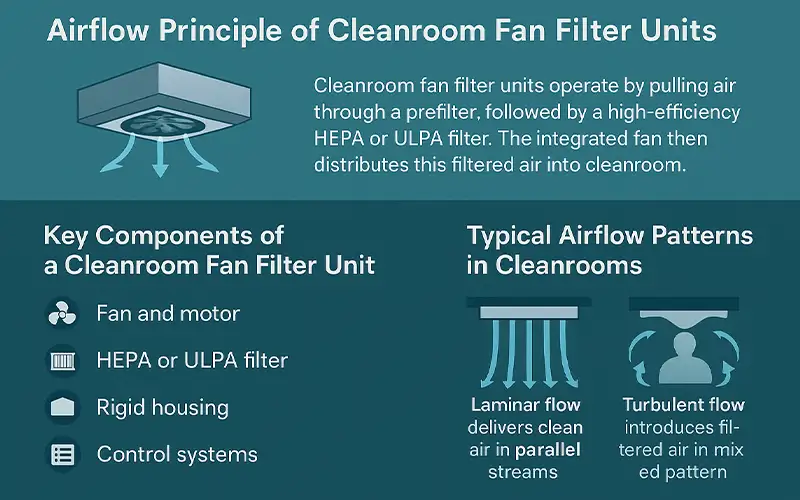
A cleanroom fan filter unit (FFU) works by pulling ambient or recirculated air through a prefilter to capture large particles and extend the life of the main filter. The air then passes through a HEPA or ULPA filter, removing up to 99.99% of microscopic particles such as dust, microorganisms, and aerosols.
Once filtered, the air is pushed into the cleanroom in a controlled manner, ensuring a constant supply of clean air to maintain the required ISO class. According to the U.S. Environmental Protection Agency (EPA), HEPA filters are capable of capturing particles as small as 0.3 microns with exceptional efficiency (EPA guide on air cleaning).
An FFU consists of several critical components:
Fan and motor: Provide the airflow needed to push air through the filtration media.
Prefilter: Captures coarse dust and fibers to protect the main filter.
HEPA or ULPA filter media: Traps fine particles to meet cleanroom cleanliness standards. ULPA filters can capture particles as small as 0.12 microns.
Housing: Ensures structural integrity, minimizes leaks, and supports installation in ceiling grids or standalone modules.
Control system: Adjusts fan speed, monitors filter pressure drop, and integrates with cleanroom automation systems.
For technical specifications and classifications of HEPA and ULPA filters, see ASHRAE’s filtration standards.
Fan filter units can deliver clean air using two main airflow strategies:
Laminar flow: Supplies air in uniform, parallel streams, pushing contaminants away from critical work areas. This is common in ISO Class 1–5 cleanrooms.
Turbulent flow: Distributes air in a mixed pattern, diluting contaminants evenly throughout the space. This approach is often used in less stringent environments, such as ISO Class 6–9 cleanrooms.
The choice of airflow pattern depends on the required cleanliness level, room layout, and the processes being performed.
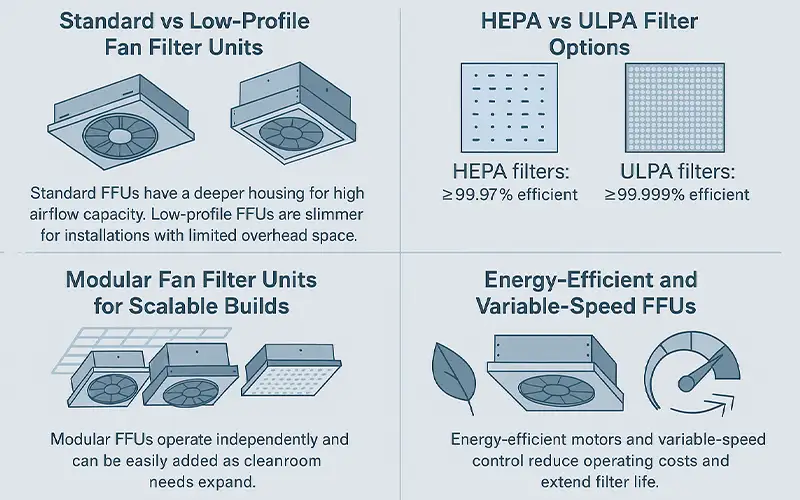
Standard FFUs are designed with a deeper housing, making them suitable for most cleanroom ceiling grids and offering high airflow capacity. Low-profile units, on the other hand, are built with a slimmer design for installations with limited overhead space, such as retrofits or facilities with tight plenum heights. While low-profile units save space, they may have slightly reduced airflow compared to standard models.
Cleanroom FFUs can be equipped with either HEPA or ULPA filters, depending on cleanliness requirements:
HEPA filters: Capture at least 99.97% of particles ≥0.3 microns. Commonly used in ISO Class 5–8 cleanrooms.
ULPA filters: Capture at least 99.999% of particles ≥0.12 microns. Required for ISO Class 1–4 environments, such as semiconductor wafer fabrication or advanced pharmaceutical manufacturing.
Modular FFUs allow cleanrooms to expand or reconfigure easily without major structural changes. Each FFU operates independently, making it possible to add more units as the cleanroom grows. This flexibility is especially valuable for industries with rapidly evolving production needs, like biotech and microelectronics.
Energy-efficient FFUs use advanced motors such as electronically commutated (EC) motors to reduce power consumption while maintaining airflow performance. Variable-speed control allows users to adjust airflow rates based on occupancy levels, cleanliness requirements, or process changes, lowering operating costs and extending filter life.
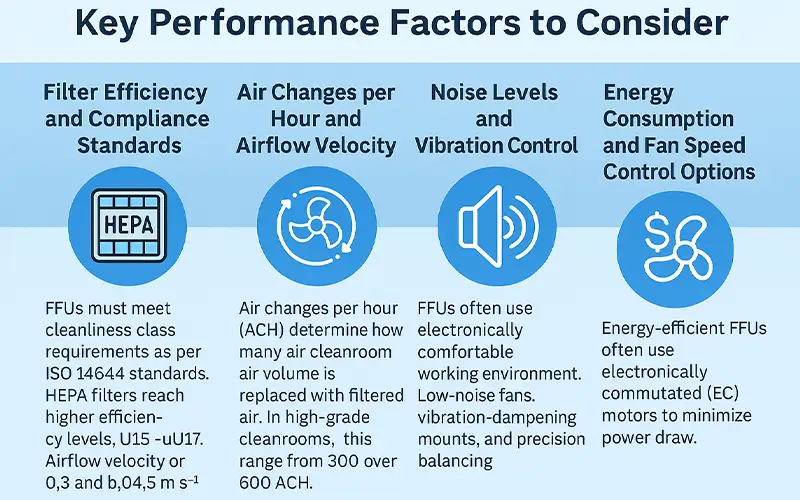
One of the most important performance factors for cleanroom fan filter units is the filtration efficiency. FFUs must meet the cleanliness class requirements defined in ISO 14644 standards. HEPA filters are typically rated under EN 1822 classifications (such as H13 or H14), while ULPA filters reach higher efficiency levels (U15–U17). The choice depends on the cleanroom class and the sensitivity of the processes taking place inside.
Air changes per hour (ACH) determine how many times the cleanroom’s entire air volume is replaced with filtered air. In high-grade cleanrooms, this can range from 300 to over 600 ACH. Airflow velocity, usually between 0.3 and 0.45 meters per second for laminar flow systems, must be consistent to prevent turbulence and particle migration.
FFUs should operate quietly to maintain a comfortable working environment, especially in laboratories and assembly areas where concentration is critical. Low-noise fans, vibration-dampening mounts, and precision balancing reduce both audible noise and micro-vibrations that could interfere with sensitive equipment.
Energy-efficient FFUs often use electronically commutated (EC) motors to minimize power draw without compromising performance. Variable-speed controls allow operators to adjust fan output based on contamination risk or process demand, reducing energy costs and extending filter life. For facilities operating large arrays of FFUs, this can result in significant long-term savings.
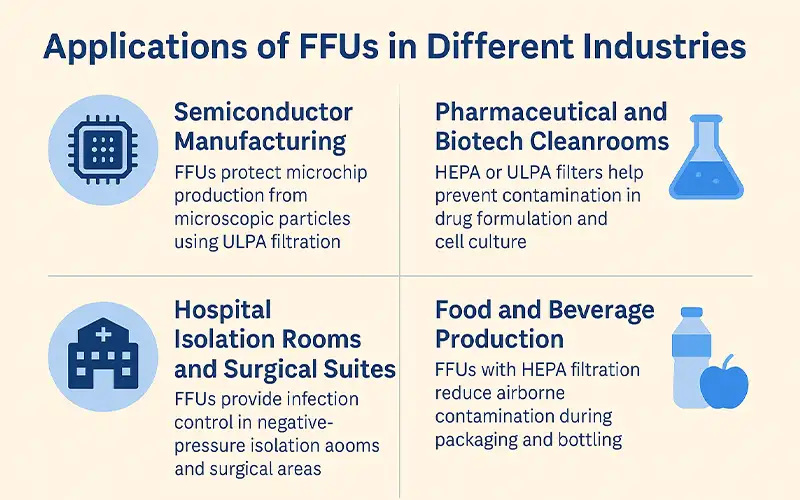
In semiconductor fabrication plants, FFUs are essential for maintaining ultra-clean environments required for microchip production. Even microscopic particles can damage wafers and reduce yield. FFUs with ULPA filters are commonly used to meet ISO Class 1–5 requirements, delivering uniform laminar airflow to protect sensitive processes like photolithography and wafer inspection.
Pharmaceutical and biotechnology facilities rely on FFUs to meet stringent contamination control standards outlined in GMP guidelines. In these cleanrooms, FFUs with HEPA or ULPA filters help prevent microbial contamination during drug formulation, sterile packaging, and cell culture processes. Their modular design allows for scalability as production demands grow.
In healthcare settings, FFUs are deployed in negative-pressure isolation rooms to contain airborne pathogens, and in positive-pressure surgical suites to protect patients from infection. HEPA filtration ensures removal of bacteria, viruses, and other harmful particulates, supporting compliance with infection control protocols such as those recommended by the CDC.
FFUs are used in food processing facilities to maintain hygienic conditions and extend product shelf life. They help reduce airborne contamination during critical stages like packaging, bottling, and preparation of ready-to-eat products. By integrating FFUs with HEPA filtration into production lines, facilities can meet HACCP and ISO 22000 food safety requirements.
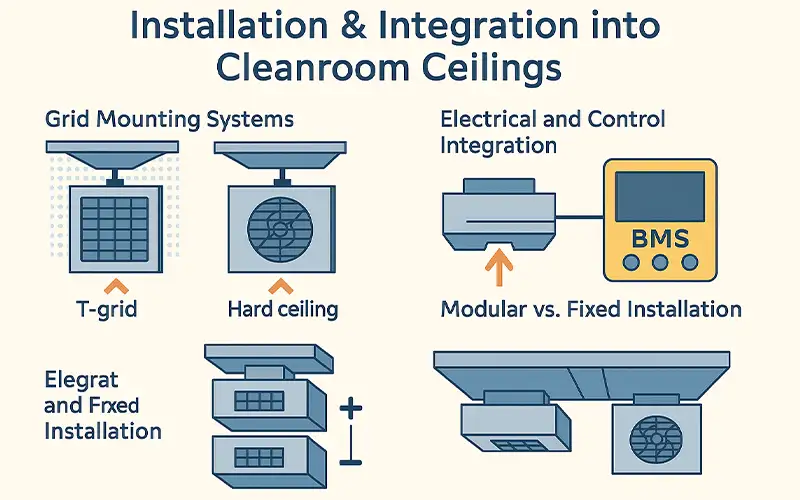
Cleanroom fan filter units can be installed into various ceiling configurations, with the most common being T-grid and hard ceiling systems. T-grid mounting offers flexibility for repositioning or replacing FFUs without major construction, making it ideal for modular cleanroom designs. Hard ceiling integration, on the other hand, provides a seamless look and can help reduce air leakage, which is critical in high-performance cleanrooms.
FFUs require electrical connections for the fan motor and, in advanced models, integrated control systems. Many modern FFUs are designed to be compatible with building management systems (BMS), allowing centralized monitoring and control of fan speeds, filter pressure drop, and maintenance schedules. Some units feature variable speed drives (VSDs) for precise airflow adjustments and energy savings.
A modular FFU setup allows for scalable cleanroom expansion, where units can be added or relocated as production needs evolve. This is particularly advantageous in industries with rapidly changing technology, such as semiconductor manufacturing. Fixed installations, while less flexible, can offer higher structural integrity and better long-term sealing performance in environments that require stable, unchanging configurations.
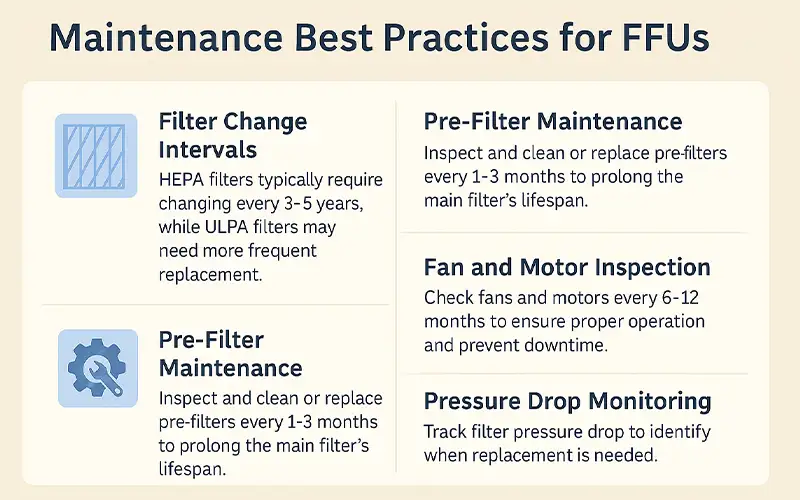
The lifespan of an FFU’s main filter depends on its type and operating conditions. HEPA filters typically require replacement every 3–5 years in controlled environments, while ULPA filters may need more frequent changes due to their finer filtration. Actual intervals should be based on performance monitoring rather than time alone, ensuring optimal efficiency and compliance with cleanroom standards.
Pre-filters capture larger particles before they reach the HEPA or ULPA filter, significantly extending the life of the main filter. These should be inspected and either cleaned or replaced every 1–3 months, depending on the contamination load. Regular pre-filter maintenance reduces pressure drop and helps maintain consistent airflow.
Fans and motors should be checked periodically for signs of wear, imbalance, or abnormal noise. Lubrication (if applicable) and tightening of mechanical connections help prevent downtime. Many facilities schedule inspections every 6–12 months to ensure uninterrupted operation.
Monitoring the pressure drop across the filter is essential to determining when it is time for replacement. A sudden rise in pressure drop may indicate filter clogging, while a gradual increase signals natural loading over time.
Integrating differential pressure gauges or sensors with a building management system (BMS) enables real-time tracking and proactive maintenance planning.
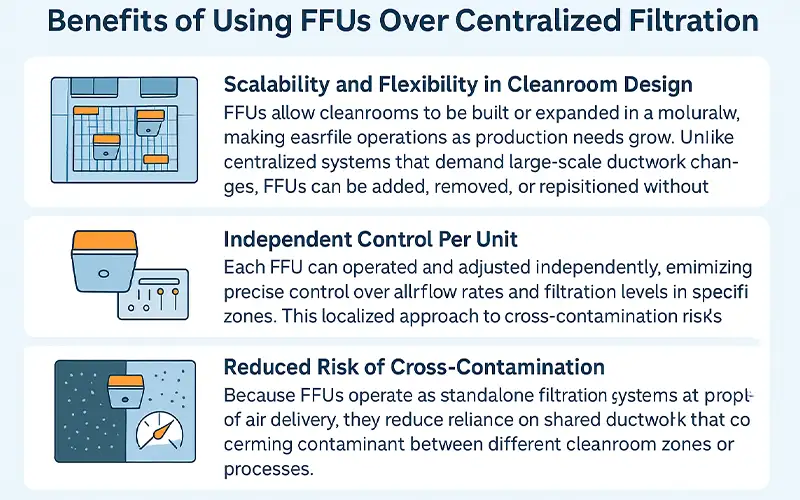
Fan filter units (FFUs) allow cleanrooms to be built or expanded in a modular way, making it easier to scale operations as production needs grow. Unlike centralized systems that require large-scale ductwork changes, FFUs can be added, removed, or repositioned without significant structural modifications.
Each FFU can be operated and adjusted independently, enabling precise control over airflow rates and filtration levels in specific zones. This feature is especially valuable in multi-process cleanrooms where different areas may require different cleanliness classifications or operational schedules.
Because FFUs operate as standalone filtration systems at the point of air delivery, they reduce reliance on shared ductwork that can carry contaminants between spaces. This localized approach to filtration minimizes cross-contamination risks between different cleanroom zones or processes.
FFUs make it possible to reduce energy consumption during off-peak hours by operating only the units needed for active processes. Variable-speed fan control further enhances efficiency, lowering power usage while maintaining required cleanliness levels in active zones.
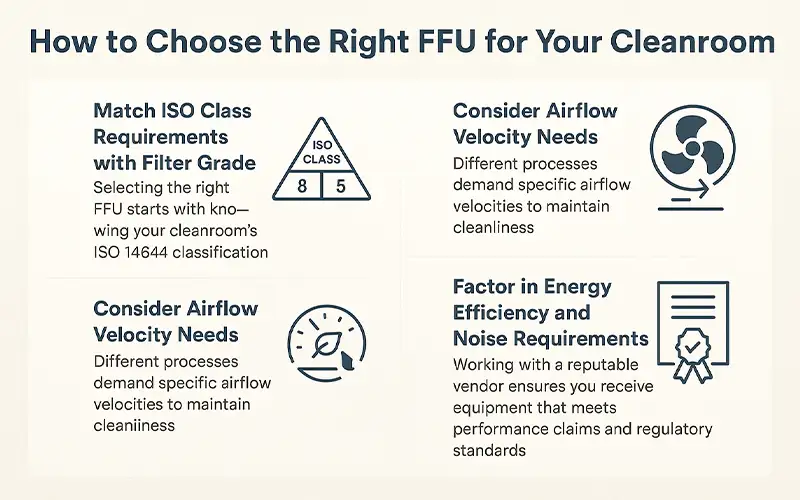
Selecting the right FFU starts with knowing your cleanroom’s ISO 14644 classification. Lower ISO class numbers (e.g., ISO Class 5) require higher filtration performance, often achieved with ULPA filters, while higher ISO class numbers (e.g., ISO Class 8) may be served by high-quality HEPA filters. Ensuring the filter grade meets EN 1822 or equivalent standards is essential for compliance and consistent particle control.
Different processes demand specific airflow velocities to maintain cleanliness. Semiconductor manufacturing may require high-velocity laminar flow to protect wafers, while pharmaceutical applications may operate at lower velocities to balance air quality with comfort. Choosing an FFU that can deliver the correct cubic feet per minute (CFM) or meters per second (m/s) flow rate is critical.
Energy-efficient FFUs with variable-speed motors reduce operational costs over time, especially in partial-load conditions. Low-noise operation is equally important in environments with high FFU density, as excessive noise can cause discomfort for personnel. Reviewing energy ratings and acoustic specifications before purchase ensures long-term satisfaction.
Working with a reputable vendor ensures you receive equipment that meets performance claims and regulatory standards. Look for suppliers with ISO-certified manufacturing, proven experience in your industry, and documented test reports.
Reliable after-sales support, including spare parts availability and technical assistance, helps extend the operational life of your FFUs and reduces downtime risk.


Leave a comment