
Expert Support
Available 24/7 via chat
Available 24/7 via chat

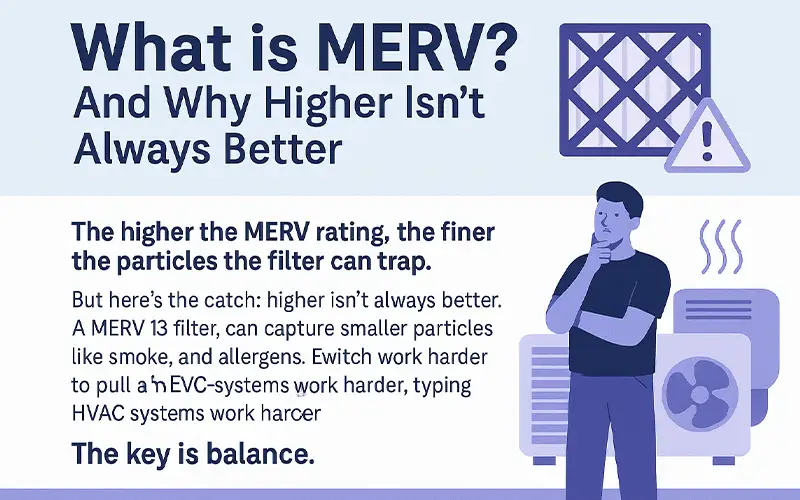
MERV stands for Minimum Efficiency Reporting Value. It is a standardized scale developed by ASHRAE (the American Society of Heating, Refrigerating and Air-Conditioning Engineers) that ranks air filters on a scale from 1 to 16 based on their ability to capture airborne particles. The higher the MERV rating, the more efficient the filter is at trapping smaller particles.
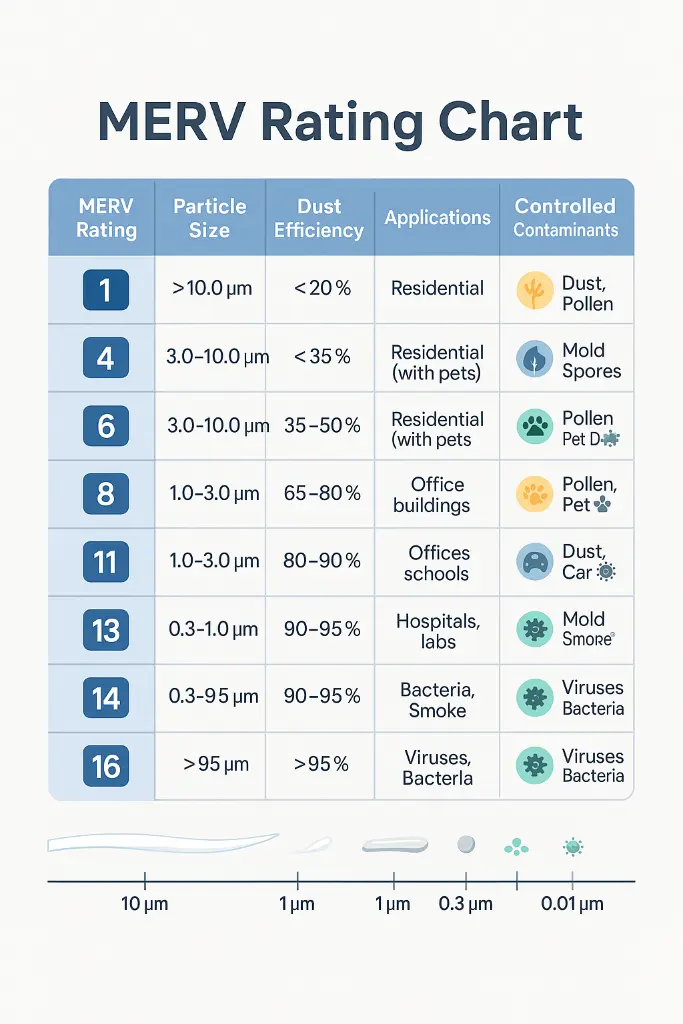
Filters with lower MERV ratings (1–4) can trap large particles like dust mites and pollen, while higher MERV filters (13–16) can capture finer particles such as bacteria, smoke, and some viruses. This makes MERV a useful tool for comparing residential and commercial air filters side by side.
You can read more about MERV ratings and test methods on the ASHRAE official website.
Although it may seem like a higher MERV rating automatically means better air quality, it’s not always the right choice for every system. High-MERV filters have tighter media and higher resistance to airflow, which can place additional strain on HVAC systems that aren’t built to handle them.
This can lead to reduced airflow, inefficient heating or cooling, increased energy bills, and even damage to the blower motor over time. According to the EPA Indoor Air Quality Guide, using a filter that is too restrictive can negatively impact your HVAC system’s performance and lifespan.
For most residential homes, filters rated between MERV 8 and MERV 11 offer an optimal balance between particle capture and system compatibility. These filters efficiently remove common household contaminants like dust, pet dander, and mold spores, without overburdening your HVAC system.
Before upgrading to a higher MERV filter, consult your HVAC technician or review your system’s specifications to ensure compatibility.
Understanding the MERV rating system is key to choosing the right air filter for your home. Each level on the MERV chart represents a different filtration capability based on the size and type of airborne particles it can trap. Here’s a breakdown of what each MERV range typically offers:
These filters provide minimal filtration and are best suited for environments where dust and large particles are the primary concern. They can trap:
Dust particles
Carpet fibers
Pollen
They are commonly found in older HVAC systems or window AC units. While they offer budget-friendly options, they don’t significantly improve indoor air quality.
This range strikes a good balance between airflow and particle removal, making it a top choice for most homes. Filters in this category capture:
Mold spores
Dust mites
Pet dander
MERV 7 or 8 filters are widely used in residential central air systems and offer a notable improvement over lower-rated filters.
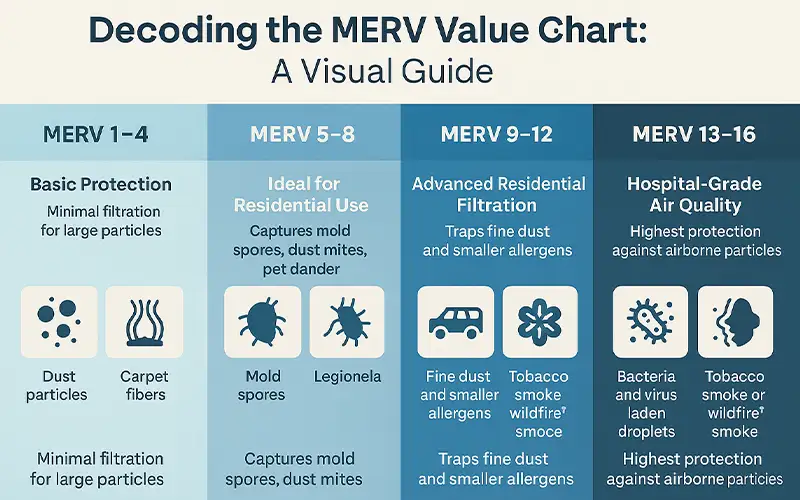
These filters provide enhanced filtration, ideal for households with allergy sufferers or where air quality is a higher priority. They can trap:
Fine dust and vehicle exhaust
Legionella (legionnaires’ disease bacteria)
Larger airborne allergens
While MERV 11 or 12 filters may slightly restrict airflow in older HVAC units, they’re generally safe for newer systems designed to handle better filtration.
Filters in this high-efficiency range are used in healthcare and cleanroom environments but are also increasingly found in premium residential systems. They capture:
Bacteria and virus-laden droplets
Tobacco smoke and wildfire smoke
Sneezed particles and fine aerosols
These filters can significantly improve indoor air quality but may require HVAC systems with stronger fan motors or professional evaluation before installation.
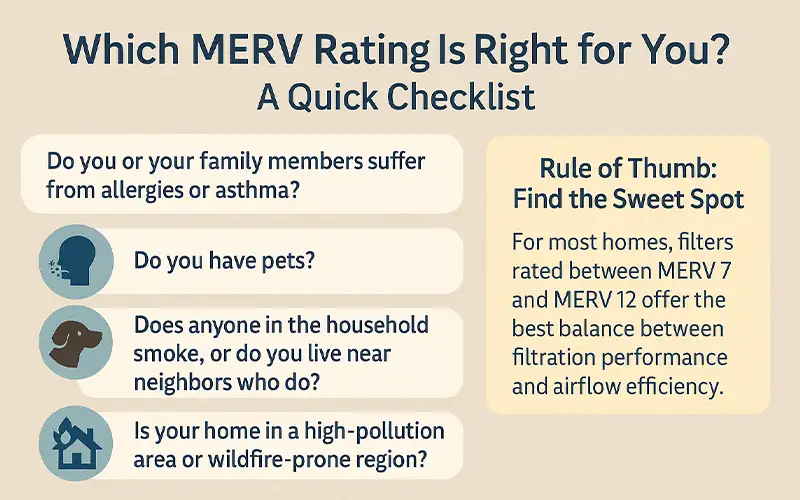
Not sure which MERV level fits your home? This quick self-assessment will help guide your decision based on your household’s unique needs and sensitivities. Ask yourself the following questions:
If yes, a higher MERV filter (9–12) may help trap allergens like pollen, mold spores, and dust mites more effectively, providing relief through cleaner indoor air.
Pet dander is a common indoor pollutant. If you have dogs, cats, or other furry animals, consider a MERV 8 or higher to help reduce airborne allergens and pet-related debris.
Tobacco smoke contains fine particles that require higher-efficiency filters to capture. MERV 13 and above are more effective at filtering smoke-related contaminants.
Homes in urban areas, near highways, or regions impacted by wildfires will benefit from filters in the MERV 11–13 range to capture fine particulates and smoke residues.
For most homes, filters rated between MERV 7 and MERV 12 offer the best balance between filtration performance and airflow efficiency. They provide meaningful air quality improvement without overburdening residential HVAC systems.
This checklist serves as a starting point. When in doubt, consult your HVAC system’s specifications or speak with a professional to ensure compatibility with your selected MERV rating.
Choosing the right MERV rating is only the first step. Proper maintenance is equally important to ensure your air filter performs effectively over time. Neglecting filter care can result in poor indoor air quality, reduced HVAC efficiency, and higher utility bills.
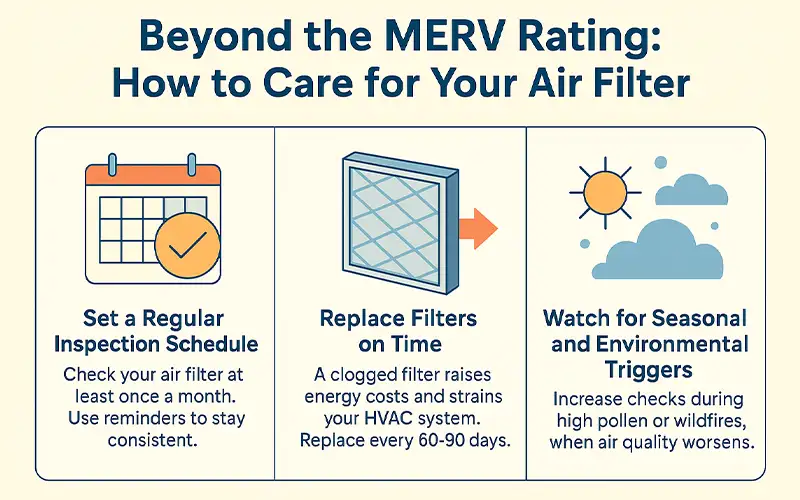
Air filters should be checked at least once a month—especially during high-usage seasons like summer and winter. Dust, pollen, pet dander, and other airborne particles can build up quickly, even on higher-rated filters. Set a phone reminder or mark your calendar to inspect the filter regularly.
A clogged filter restricts airflow, causing your HVAC system to work harder. This not only increases energy consumption but can also lead to premature wear and tear on system components. For most homes, replacing filters every 60 to 90 days is recommended. If you have pets, allergies, or live in a high-pollution area, more frequent changes may be necessary.
During allergy season or wildfire events, outdoor air quality can drop significantly. When windows are open or ventilation systems pull in outside air, more particulates enter your home. In these cases, it’s smart to check and possibly replace your filter sooner than scheduled.
By staying proactive with maintenance, you can extend the life of your HVAC system, reduce energy costs, and ensure healthier air for your household—all while making the most of your chosen MERV-rated filter.


Leave a comment