
Expert Support
Available 24/7 via chat
Available 24/7 via chat

Airborne transmission is one of the most challenging biosecurity issues in modern livestock farming.
Unlike direct contact or contaminated equipment, pathogens carried through the air can bypass many traditional barriers and enter barns unnoticed.
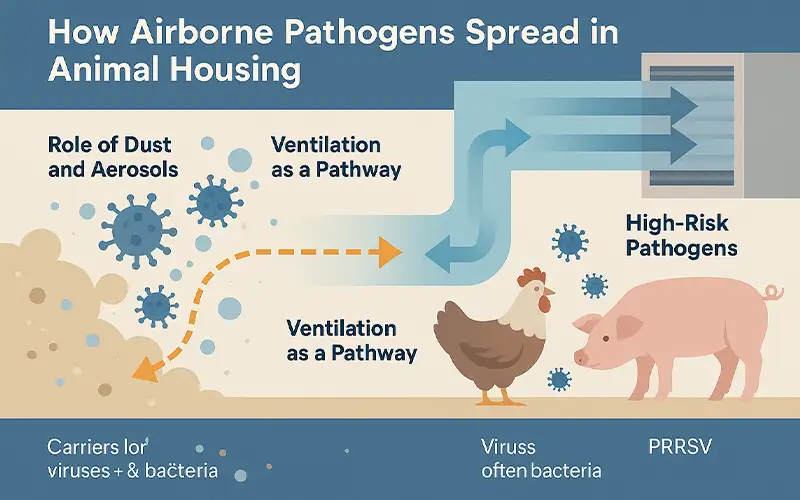
Dust particles, dander, and aerosols generated inside animal housing can act as carriers for viruses and bacteria. These tiny particles remain suspended in the air and are easily transported through ventilation systems.
According to the Centers for Disease Control and Prevention (CDC), aerosols are a primary route for respiratory disease spread in confined spaces, making ventilation control essential.
Mechanical and natural ventilation systems, while necessary to maintain air exchange, can also introduce pathogens from surrounding areas.
For example, studies show that PRRSV has the ability to travel several kilometers under favorable wind conditions. Without adequate filtration, these viruses can enter barns through incoming air streams.
PRRSV: Capable of spreading through aerosols, posing constant risks to swine farms.
Avian Influenza: Easily transmitted between poultry houses via airborne droplets, especially in high-density farming areas.
Other Respiratory Agents: Mycoplasma, bacterial spores, and coronaviruses in livestock can also be airborne, increasing the complexity of control.
Effective air filtration strategies, as recommended by FAO for avian influenza control, are increasingly seen as non-negotiable for farms aiming to protect animal health and prevent economic disruption.
Air filtration in livestock housing is one of the most effective defenses against airborne diseases.
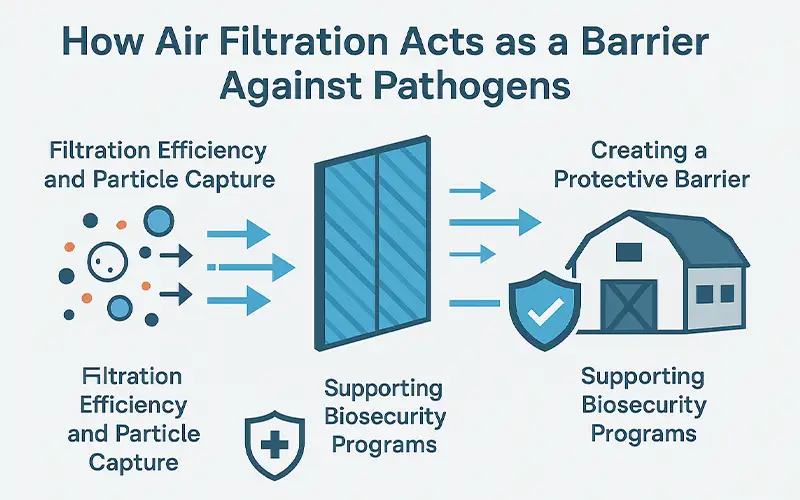
By forcing incoming air through high-efficiency filters, pathogens are trapped before they can reach animals, reducing the risk of outbreaks.
Filters rated under standards such as ISO 16890 and MERV are designed to capture particles in the size range where viruses often attach to dust and aerosols.
For example, a MERV 15 pocket filter can capture over 85% of particles in the 0.3–1.0 micron range, where PRRSV and avian influenza are most likely to be transported. According to the EPA, higher MERV filters significantly reduce airborne pathogens when properly installed and maintained.
When placed at ventilation intakes, filters act as a physical shield between outside air and the animals inside. This is particularly important in regions with dense farm populations, where pathogens can move quickly between facilities.
Properly designed filtration systems help maintain negative or positive pressure environments that further control airflow and reduce contamination risk.
Air filtration complements other biosecurity measures such as controlled entry points, sanitation protocols, and vaccination programs.
The World Organisation for Animal Health (WOAH) emphasizes that combining multiple layers of defense is the most reliable way to prevent and control animal disease outbreaks.
Different types of air filters are applied in livestock environments depending on the level of risk, facility design, and budget.
Each technology offers unique benefits for controlling airborne pathogens such as PRRSV and avian influenza.
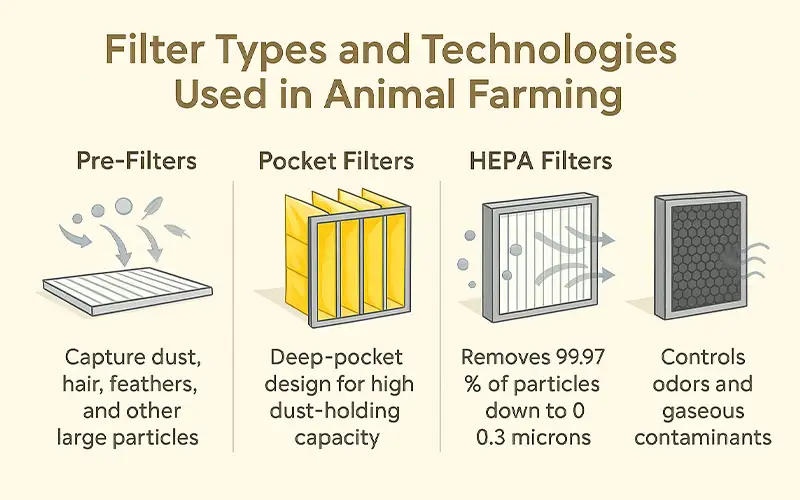
Pre-filters, often rated MERV 6–8, are used as the first line of defense. They capture dust, hair, feathers, and other large particles before air reaches the primary filter.
By reducing the load on higher-efficiency filters, pre-filters extend overall system life and help maintain stable airflow.
MERV 13–15 pocket filters are commonly installed in animal housing due to their high dust-holding capacity and efficiency at capturing fine particles.
Their deep-pocket design allows for greater air volume handling while resisting clogging, making them ideal for barns and poultry houses with high particulate loads.
In high-risk operations, such as breeding facilities or regions with active outbreaks, HEPA filters may be used. These capture 99.97% of particles down to 0.3 microns, ensuring that even aerosolized virus carriers are removed from the air. While more expensive, HEPA technology provides the highest level of biosecurity.
Where odor or gaseous contaminants are a concern, activated carbon filters can be added to control ammonia and other volatile compounds.
This not only improves worker conditions but also reduces stress on animals, supporting better productivity.
Effective air filtration in animal farming requires more than just selecting high-efficiency filters.
The design of the system plays a crucial role in ensuring protection against airborne pathogens while maintaining animal comfort and facility efficiency.
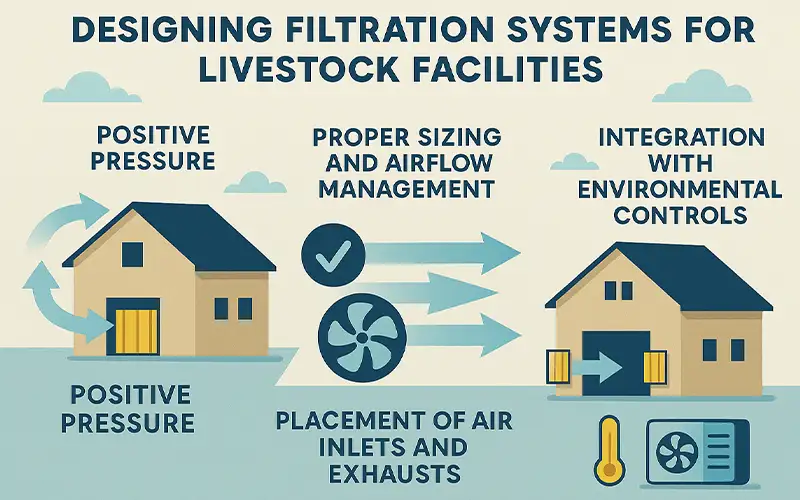
The choice between positive and negative pressure systems depends on facility goals. Positive pressure systems push filtered air into barns, creating an environment where outside contaminants are kept out.
Negative pressure systems, on the other hand, draw air through filters into the barn, controlling airflow direction but requiring strict maintenance to prevent leaks.
Filtration systems must be designed to match the airflow needs of each building. Undersized systems can restrict ventilation, leading to poor air quality and heat stress in animals.
Oversized systems may result in unnecessary energy consumption. Proper balance ensures optimal biosecurity without sacrificing operational efficiency.
Filter placement is critical. Inlets should be positioned to ensure even distribution of clean air across animal housing areas.
Exhaust points must be designed to remove stale, contaminated air efficiently without creating drafts or dead zones where pathogens can accumulate.
Air filtration should work in harmony with other systems such as heating, cooling, and humidity control.
Coordinated design allows facilities to maintain stable temperatures and moisture levels, both of which impact animal health and pathogen survival rates.
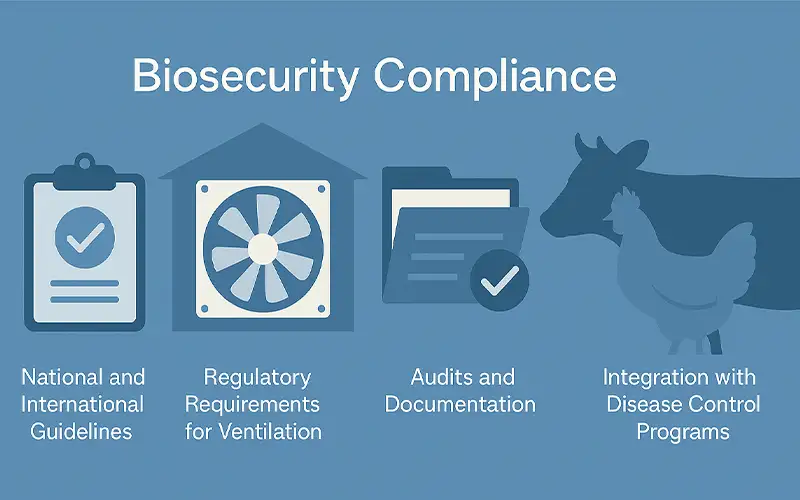
Livestock facilities must adhere to established biosecurity frameworks designed to limit the spread of infectious diseases.
Standards from organizations such as the World Organisation for Animal Health (WOAH, formerly OIE) and regional agricultural authorities emphasize the importance of controlling airborne transmission.
Air filtration plays a central role in meeting these requirements, particularly for high-value herds and poultry operations.
Government agencies often set minimum standards for ventilation and air quality in livestock housing. These regulations may include requirements for filtration efficiency, airflow rates, and monitoring of air systems.
Compliance not only protects animal health but also reduces liability and ensures eligibility for international trade where disease-free certification is mandatory.
Maintaining proper documentation of filter specifications, maintenance schedules, and airflow performance is essential for audits.
Auditors may require proof that facilities are using appropriately rated filters and that systems are regularly inspected and maintained. Consistent records strengthen compliance efforts and demonstrate a facility’s commitment to biosecurity.
Filtration is most effective when combined with other biosecurity measures such as vaccination programs, controlled animal movement, and sanitation protocols.
Regulatory agencies often encourage or require a holistic approach to disease prevention, in which air filtration is a proven and measurable barrier.
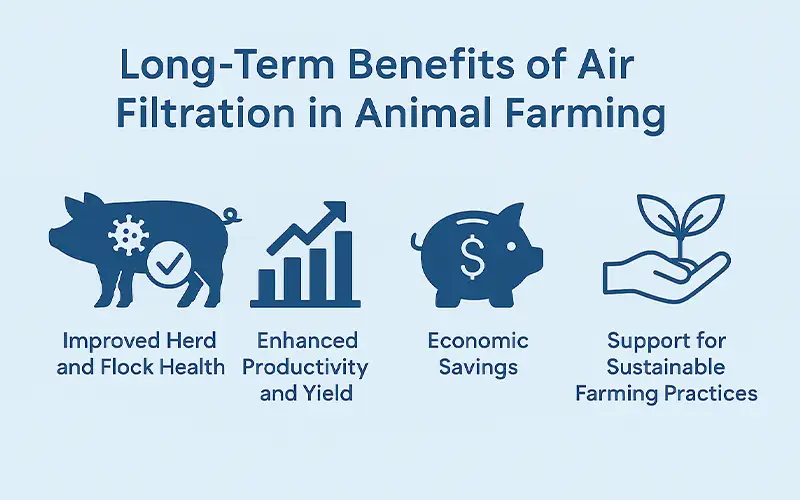
Consistent use of properly rated air filters reduces exposure to airborne pathogens, resulting in healthier animals.
Lower infection rates mean fewer veterinary treatments, less use of antibiotics, and improved overall productivity.
Healthier livestock translates into better growth rates, feed conversion efficiency, and reproductive performance.
Poultry farms, for example, see reduced mortality and higher egg production when airborne contaminants are controlled through effective filtration.
While filtration systems require upfront investment, the long-term cost savings are substantial. Reduced disease outbreaks lower treatment expenses and minimize losses from culling.
In addition, extended filter life and optimized HVAC performance decrease energy and maintenance costs over time.
Air filtration aligns with global sustainability goals by reducing the need for chemical interventions and supporting responsible antibiotic use.
By lowering the environmental impact of livestock operations, filtration also helps farms meet growing consumer demand for sustainable and biosecure food production.


Leave a comment