
Expert Support
Available 24/7 via chat
Available 24/7 via chat

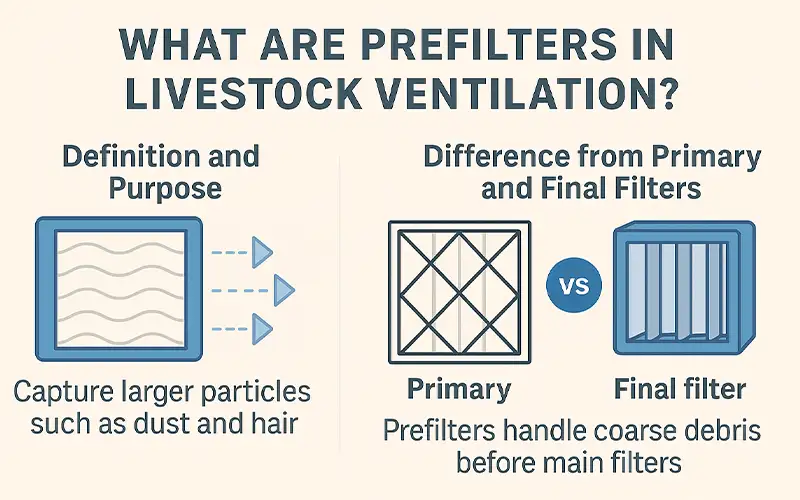
Prefilters in livestock ventilation are the first stage of air filtration, designed to capture larger particles such as dust, hair, feathers, and chaff before they reach downstream filters.
By removing these coarse contaminants, prefilters reduce the load on primary and final filters, extending their service life and maintaining stable airflow in barns and housing systems.
This staged approach ensures that ventilation fans operate efficiently and energy costs remain controlled.
While prefilters handle larger particles, primary filters (such as MERV 8–11 panel or pocket filters) target finer dust and bioaerosols that affect animal respiratory health.
Final filters—often high-efficiency particulate air (HEPA) or near-HEPA units—are reserved for high-biosecurity environments like swine AI studs or poultry hatcheries, where pathogen exclusion is critical.
Prefilters are therefore not a replacement but a critical first barrier that protects advanced filtration layers. According to the U.S. Environmental Protection Agency (EPA), a layered filtration system improves both air quality and filter economics.
Similarly, ASHRAE emphasizes staged filtration design for sustainable HVAC performance in agricultural and industrial applications.
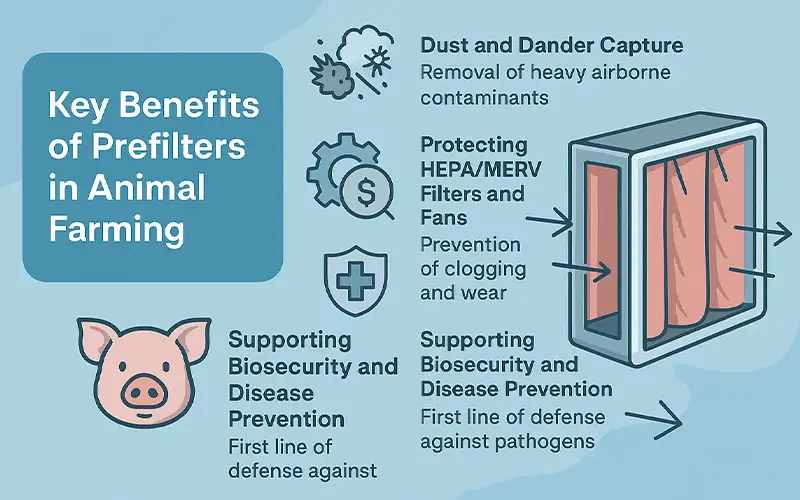
Prefilters remove heavy airborne contaminants such as dust, feed particles, and animal dander that are common in barns and housing units.
By keeping these coarse materials out of the airstream, they improve indoor air quality and help reduce respiratory stress in livestock.
Because prefilters intercept larger debris, downstream MERV-rated filters and HEPA units are shielded from premature clogging.
This protection extends the service life of costly high-efficiency filters and reduces wear on ventilation fans. As ASHRAE highlights, staged filtration design is critical for maintaining both airflow stability and equipment longevity.
By reducing the frequency of filter replacements and cleaning cycles, prefilters directly lower maintenance costs.
They also minimize pressure drop across the system, which keeps fan energy use in check. Over time, this translates into measurable savings in both filter expenditures and electricity consumption.
Prefilters form the first line of defense against airborne contaminants that may carry pathogens. In swine, poultry, and dairy facilities, preventing contaminated particles from reaching sensitive areas supports biosecurity measures.
According to the U.S. Department of Agriculture (USDA), controlling airborne risks is a key component of livestock disease prevention programs.
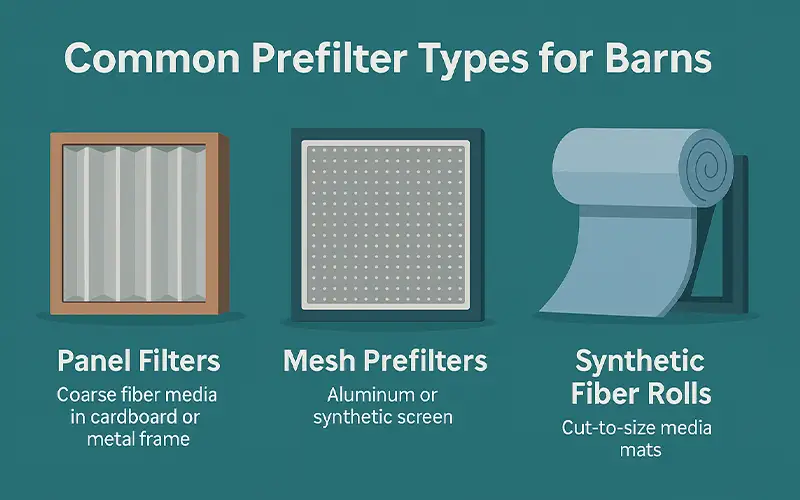
Panel prefilters are flat filters made with cardboard or metal frames and filled with coarse fiber media.
They are widely used as the first stage of filtration in barn ventilation systems. Their simple construction makes them cost-effective and easy to replace, providing basic protection against dust and large airborne particles.
Mesh prefilters use aluminum, galvanized steel, or synthetic screens to trap larger debris such as straw fragments, feathers, or heavy dust. They are washable and reusable, making them suitable for high-dust environments where frequent cleaning is necessary.
Mesh screens are often installed at air inlets in poultry and swine barns to stop coarse material before it reaches the main filters.
Synthetic fiber prefilter rolls are cut-to-size media mats mounted on frames or in roll filter systems. These filters provide higher dust-holding capacity than simple mesh screens and can be changed or advanced periodically.
Their flexibility allows them to handle varying levels of dust load in dairy, swine, or poultry facilities, reducing maintenance on downstream filters and fans.
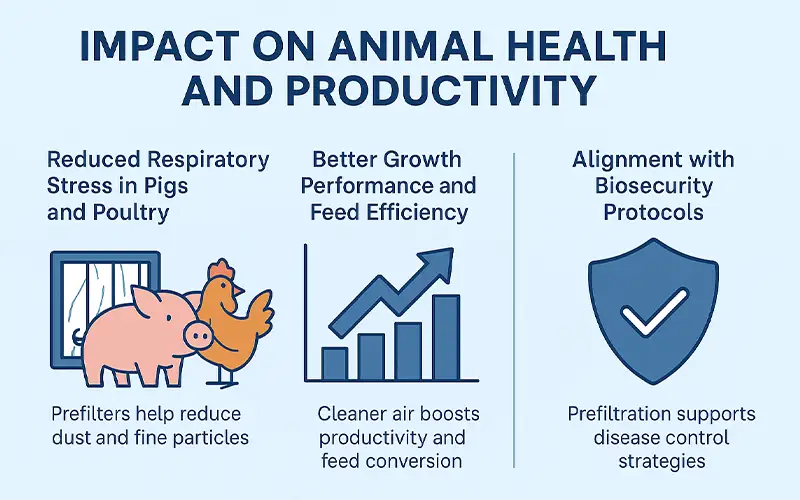
By capturing dust, dander, and fine particulates before they circulate in livestock housing, prefilters significantly reduce the respiratory load on animals.
Lower airborne particulate concentrations directly decrease the incidence of respiratory distress syndromes in swine and poultry, supporting herd health and minimizing veterinary intervention costs.
The U.S. National Library of Medicine highlights how airborne dust exposure contributes to respiratory diseases in farm animals.
Cleaner air environments enable more efficient nutrient utilization. With reduced respiratory stress, animals allocate less metabolic energy to coping with environmental challenges and more toward growth and feed conversion.
This results in measurable improvements in average daily gain (ADG), feed conversion ratio (FCR), and overall production metrics—key drivers of profitability in intensive farming operations.
According to FAO, environmental management plays a direct role in animal growth efficiency and welfare.
Prefilters form an integral component of multi-stage filtration strategies designed to meet biosecurity objectives.
By reducing airborne pathogen load before it reaches high-efficiency or HEPA-level filters, prefilters enhance system effectiveness against viruses such as PRRSV or avian influenza.
Their role supports compliance with recognized biosecurity guidelines and contributes to maintaining stable, high-yield production environments.
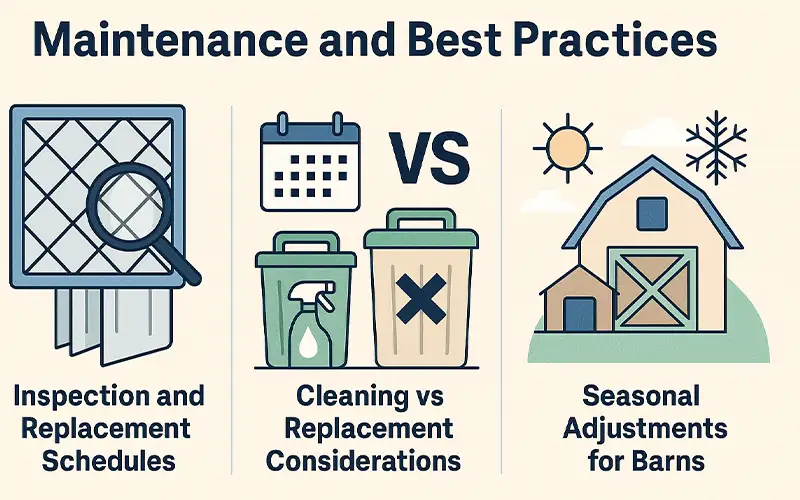
Regular inspection of prefilters is critical to maintaining consistent airflow and system performance. In livestock facilities, filters should be checked at least once per month, with replacement intervals typically ranging from 1 to 3 months depending on dust load, stocking density, and barn design.
Establishing a preventive maintenance schedule minimizes unplanned downtime and ensures ventilation efficiency.
Some prefilter formats, such as mesh or screen types, can be cleaned and reused. However, cleaning efficiency often declines over time due to fiber wear or clogging within the media.
Disposable synthetic roll or panel prefilters typically deliver more consistent performance but require scheduled replacement. A cost-benefit assessment should guide whether cleaning or full replacement delivers better long-term reliability for a given facility.
Environmental conditions drive filter loading rates. During dry, dusty seasons or harvest periods, barns may experience accelerated filter clogging, requiring shorter replacement cycles. Conversely, in colder months with reduced ventilation demand, replacement intervals may be extended.
Aligning maintenance with seasonal variations ensures stable airflow, reduces fan energy consumption, and maintains target air quality standards across production cycles.


Leave a comment