
Expert Support
Available 24/7 via chat
Available 24/7 via chat

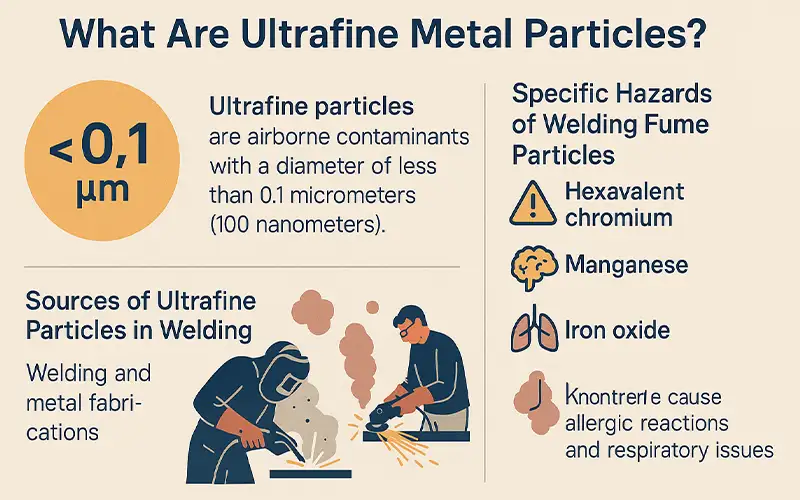
Ultrafine particles are airborne contaminants with a diameter of less than 0.1 micrometers (100 nanometers). Due to their extremely small size, they remain suspended in the air for long periods and can penetrate deeply into the lungs when inhaled.
Their high surface area also makes them chemically reactive, increasing their potential to cause harm to human health.
Welding and metal fabrication processes generate significant amounts of ultrafine particles. High heat from MIG, TIG, and stick welding vaporizes metal, which then cools rapidly into microscopic fumes. Other common sources include:
Plasma cutting, which produces concentrated fumes rich in metallic oxides.
Grinding and polishing, where abrasive contact releases fine dust and residual metal particulates.
These particles are often invisible to the naked eye but accumulate quickly in enclosed shop environments.
Not all welding fumes are the same—different metals release different toxic compounds. Some of the most concerning hazards include:
Hexavalent chromium: Generated when welding stainless steel; classified as a human carcinogen by OSHA.
Manganese: Long-term exposure is linked to neurological disorders resembling Parkinson’s disease.
Nickel: Known to cause allergic reactions and respiratory issues.
Iron oxide: Contributes to siderosis, a lung disease caused by chronic exposure.
According to the National Institute for Occupational Safety and Health (NIOSH), these ultrafine metal particles pose one of the greatest risks in welding environments, making proper air filtration essential for compliance and worker protection.
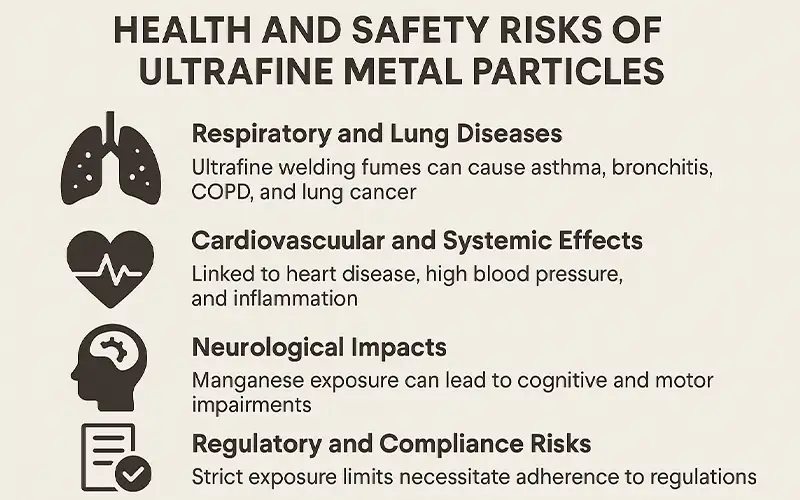
Ultrafine welding fumes penetrate deep into the alveolar region of the lungs, where the body cannot easily expel them. Long-term exposure is associated with asthma, bronchitis, chronic obstructive pulmonary disease (COPD), and in some cases, lung cancer. According to the American Lung Association, even short-term exposure can irritate the respiratory tract and reduce lung function.
Beyond the lungs, ultrafine particles enter the bloodstream and may cause oxidative stress and inflammation. Studies link chronic exposure to increased risk of cardiovascular disease, elevated blood pressure, and reduced oxygen transport capacity. Workers often report fatigue and headaches that correlate with poor air quality in welding shops.
Certain metals released during welding, such as manganese, pose risks to the nervous system. Prolonged exposure has been connected to neurological symptoms that mimic Parkinson’s disease, including tremors, slowed movement, and balance issues.
Occupational safety organizations have recognized the dangers of welding fumes and established strict limits. The Occupational Safety and Health Administration (OSHA) enforces permissible exposure limits (PELs) for many metals, including hexavalent chromium and nickel. Failure to comply can lead to fines, legal liabilities, and reputational damage for metal fabrication shops.
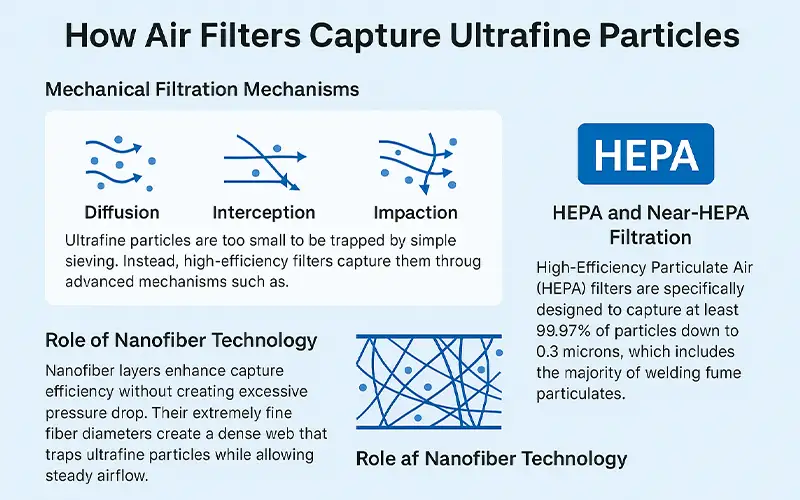
Ultrafine particles are too small to be trapped by simple sieving. Instead, high-efficiency filters capture them through advanced mechanisms such as:
Diffusion: Random motion causes ultrafine particles to collide with filter fibers and stick.
Interception: Particles following airflow streams come into direct contact with filter fibers.
Impaction: Larger particles deviate from airflow paths and are captured when they strike fibers.
These combined mechanisms make modern filters effective even against particles smaller than 0.1 microns.
Nanofiber layers enhance capture efficiency without creating excessive pressure drop. Their extremely fine fiber diameters create a dense web that traps ultrafine particles while allowing steady airflow. This balance reduces energy consumption and extends filter life compared to traditional media.
High-Efficiency Particulate Air (HEPA) filters are specifically designed to capture at least 99.97% of particles down to 0.3 microns, which includes the majority of welding fume particulates.
In welding shops, near-HEPA filters with MERV 15–17 ratings are often used as a cost-effective solution that still meets stringent air quality standards. According to the EPA, HEPA filters are among the most effective tools for reducing airborne contaminants, including ultrafine particulates.
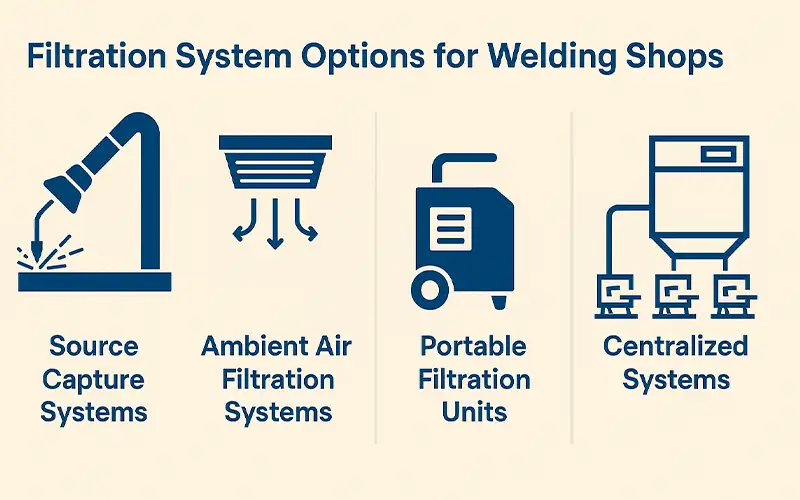
Source capture solutions remove welding fumes directly at the point of generation. Common setups include:
Fume extraction arms positioned near the weld arc.
Downdraft tables that pull fumes downward as work is performed.
Enclosed hoods or booths designed for high-volume or robotic welding stations.
These systems are highly effective because they prevent fumes from dispersing into the wider shop environment.
In shops where source capture is impractical, ambient systems are installed to clean the general air volume. These units use ceiling-mounted or free-standing air cleaners to continuously circulate and filter air. While not as targeted as source capture, they are effective for controlling background exposure across larger areas.
For small or mobile welding operations, portable units offer flexibility. They are compact, easy to move, and well-suited for temporary projects or spaces with changing layouts. However, they may lack the capacity to handle heavy, continuous welding fumes.
Large fabrication shops often benefit from centralized air filtration systems. These connect multiple workstations to a single high-capacity filtration unit, ensuring consistent air quality throughout the facility.
Though the upfront investment is higher, centralized systems provide superior efficiency and easier maintenance scheduling.
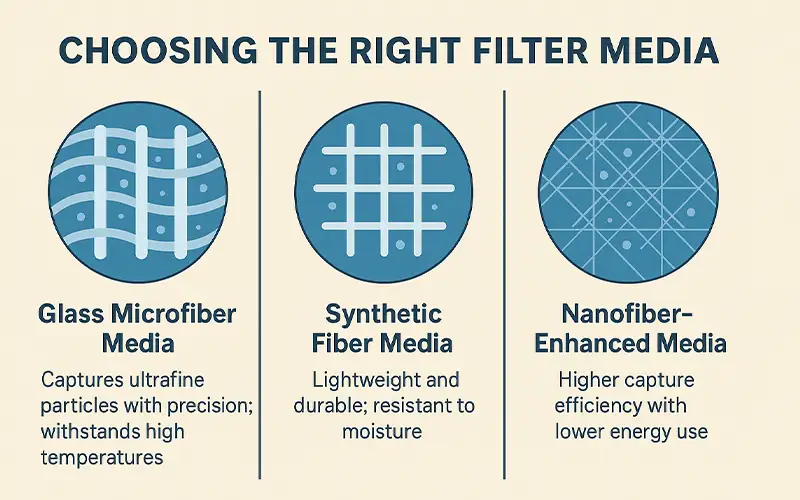
Glass microfiber filters are widely used in welding applications due to their precision in capturing ultrafine particles. They can withstand high temperatures and offer excellent filtration efficiency. However, they tend to be heavier, more brittle, and can create higher pressure drop compared to other media.
Synthetic filters are lightweight, durable, and resistant to moisture, making them ideal for variable shop conditions. They typically have lower pressure drops, which reduces energy consumption and extends filter life. While their efficiency is slightly lower than glass microfiber at the smallest particle sizes, they provide a strong balance of performance and cost-effectiveness.
Nanofiber layers applied to either glass or synthetic substrates significantly increase capture efficiency for ultrafine particles. These fibers create a dense, uniform barrier that traps particles at the surface rather than deep within the media. The result is longer service life, lower maintenance frequency, and reduced energy use.
The right choice depends on your welding shop’s needs. Glass microfiber is best for environments requiring maximum precision, synthetic is well-suited for general shop conditions, and nanofiber-enhanced media provides an advanced solution that balances high capture efficiency with energy savings. Matching media to airflow capacity and maintenance schedules ensures both compliance and operational efficiency.
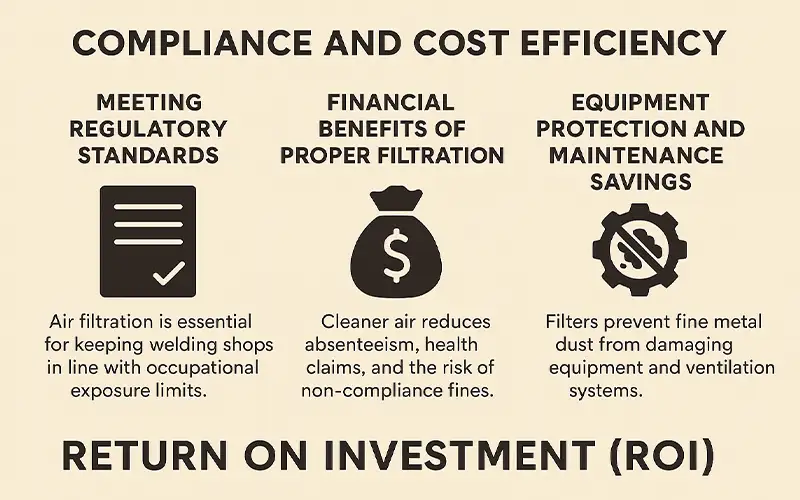
Air filtration is essential for keeping welding shops in line with occupational exposure limits. Filters with MERV 15–17 ratings or HEPA efficiency levels are often necessary to reduce concentrations of metals such as hexavalent chromium, nickel, and manganese to within acceptable thresholds. Choosing the right filtration setup ensures adherence to safety guidelines and protects facilities from costly penalties.
Although high-efficiency filters can seem expensive upfront, they deliver measurable savings over time. Cleaner air reduces employee absenteeism, minimizes long-term health claims, and lowers the risk of non-compliance fines. Additionally, maintaining air quality improves productivity by creating a more comfortable and safer environment for welders.
Effective filtration also prevents fine metal dust from damaging sensitive equipment, ventilation systems, and electronics within the shop. By minimizing contamination, filters extend the service life of HVAC systems and reduce unplanned maintenance costs.
When viewed over the lifespan of a welding operation, investing in advanced air filtration provides strong ROI. Shops gain from reduced downtime, improved worker health, and long-term operational stability—all while meeting compliance requirements.


Leave a comment