
Expert Support
Available 24/7 via chat
Available 24/7 via chat

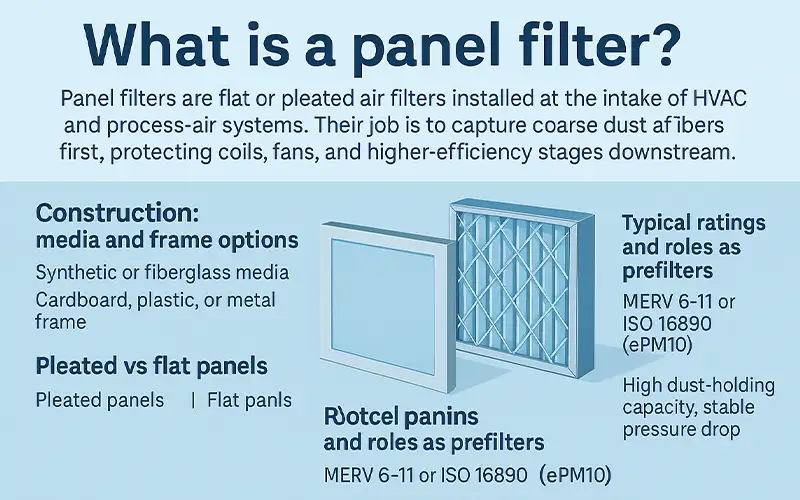
Panel filters are flat or pleated air filters installed at the intake of HVAC and process-air systems. Their job is to capture coarse dust and fibers first, protecting coils, fans, and higher-efficiency stages downstream.
As prefilters, they emphasize high dust-holding capacity and stable pressure drop over ultra-fine capture.
Most panel filters use synthetic or fiberglass media bonded to a cardboard, plastic, or metal frame. Pleated panels increase media area, improving dust-holding capacity and slowing pressure rise compared with flat pads of the same face size.
Common depths are 1, 2, or 4 inches; frames may include diagonal supports or expanded-metal backing to keep pleats from collapsing at higher face velocities.
Flat fiberglass or synthetic pads are low-cost and easy to replace, but they saturate faster and show a quicker rise in resistance.
Pleated panels add surface area for longer service life and more stable airflow at comparable loading. In multi-stage systems, pleated panels are the common choice to reduce changeout frequency of downstream bag, V-bank, or HEPA filters.
Panel filters are usually rated by MERV and/or ISO 16890. The EPA’s overview of MERV explains that MERV reports minimum efficiency across particle bands from 0.3–10 μm, helping compare products at a glance. The ISO 16890 classification expresses efficiency as ePM1/ePM2.5/ePM10 fractions for general ventilation.
As prefilters, panel filters commonly fall around MERV 6–11 or ISO ePM10 classes, targeting coarse particles that would otherwise foul coils and prematurely load finer stages.
For selection, match the rating to your dust profile and airflow limits, and verify initial/final pressure drop and dust-holding capacity at your intended face velocity.
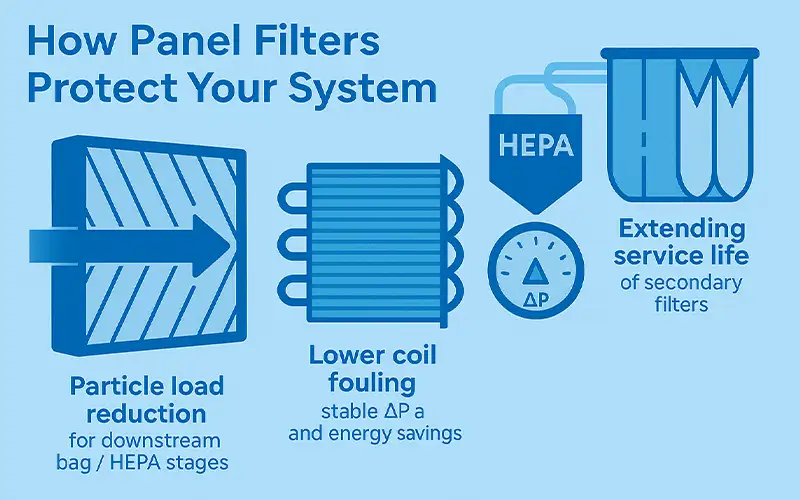
Panel filters sit at the intake and remove the bulk of coarse dust and fibers before air reaches sensitive components. By taking the first hit, they stabilize airflow, reduce unexpected shutdowns, and keep downstream filters focused on the fine particles they’re designed to capture. For context on efficiency ratings used to compare prefilters, see the EPA’s overview of MERV and the ASHRAE filtration FAQ.
Downstream pocket, V-bank, and HEPA stages are optimized for fine particulates, not bulk dust. When panel filters intercept coarse debris first, dust-holding capacity is used where it’s cheapest, and high-efficiency media stays available for sub-micron capture. The result is slower pressure rise across secondary filters, fewer emergency changeouts, and more predictable compliance with cleanroom or finish-quality targets.
Coils foul when lint and dust mat onto fins, restricting heat transfer and adding resistance. An upstream panel filter reduces that loading, so coil delta-P climbs more slowly and fans don’t need to ramp speed to hold setpoint airflow. Over time this translates to steadier supply volumes, fewer coil cleanings, and lower energy per cfm because the system avoids running at higher static to overcome preventable blockage.
When bulk contaminants are caught at the intake, downstream stages accumulate fewer grams of dust per operating hour. That extends service intervals for bag and HEPA filters, reduces labor and disposal costs, and minimizes risk of bypass from hurried changeouts. In multistage banks, a correctly sized pleated panel becomes a predictable, low-cost sacrificial stage that protects premium filters and overall system reliability.
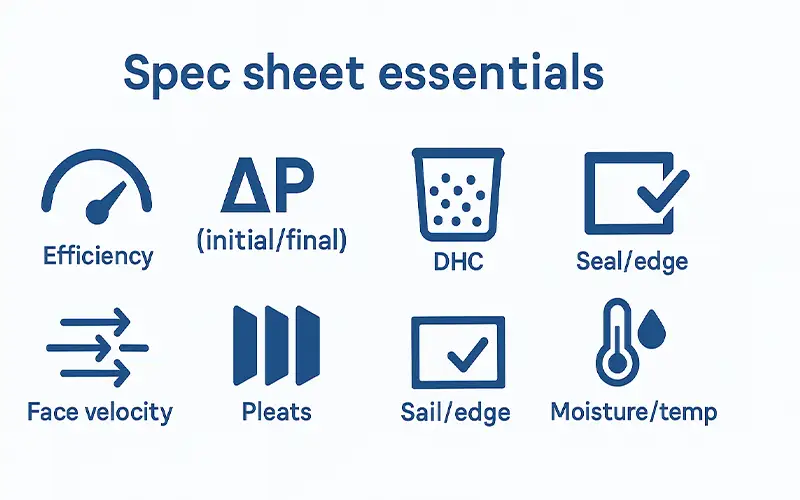
Pick filters by performance, not just materials. Prioritize ratings, resistance, capacity, and build quality that prevents leaks.
Efficiency class
Use a consistent scheme (MERV or ISO 16890). For prefilters, MERV 6–11 or ePM10 is typical.
Initial ΔP
Clean-filter resistance at the stated face velocity. Lower is better for fan headroom and energy.
Final ΔP
Recommended changeout point. Set it to protect airflow, energy, and downstream stages.
Dust-holding capacity (DHC)
Mass captured to final ΔP. Higher DHC at equal size/rating means longer service life.
Face velocity
Match datasheet test velocity to your operation; ΔP and efficiency shift with speed.
Media area (pleats)
More pleats = more area, slower ΔP rise, fewer changeouts.
Seal/edge design
Tight frames, gaskets, and backing prevent bypass and pleat collapse.
Moisture/temperature limits
Check humidity and heat ratings; choose moisture-resistant frames/media for wet or hot zones.
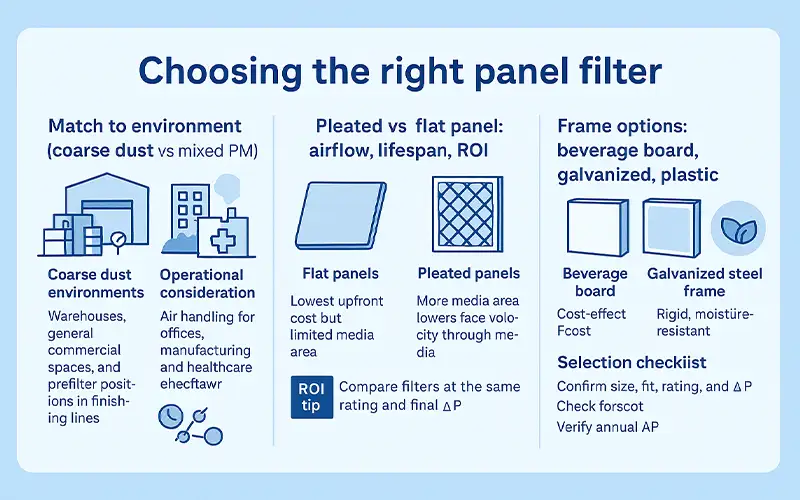
Start with your air quality, airflow limits, and maintenance goals. The best panel filter is the one that captures the right particle sizes at the lowest sustainable pressure drop, fits your frames, and delivers predictable life between changeouts.
Warehouses, general commercial spaces, and prefilter positions in finishing lines typically face larger particles. Choose filters in the MERV 6–8 or ISO ePM10 range with high dust-holding capacity and low initial ΔP to keep energy and coil fouling in check.
Air handling for offices near traffic, manufacturing with both coarse and fine debris, or healthcare support areas benefit from MERV 8–11 or ISO ePM10–ePM2.5 prefilters. Aim for pleated synthetic media that maintains efficiency without spiking resistance as it loads.
If fan headroom is limited, prioritize lower initial ΔP. If access is infrequent, prioritize higher dust-holding capacity and a higher final ΔP setpoint that your fans can support.
Lowest upfront cost and quick to change, but limited media area. They load faster, raise resistance sooner, and require shorter intervals—best for light dust with easy access.
More media area lowers face velocity through the media, slowing the rise in ΔP and extending service life. Although pricier initially, pleated panels often win on lifecycle cost by reducing changeouts, labor, and downstream filter loading.
Compare filters at the same size, rating, and final ΔP. Calculate annualized cost using changeout frequency, labor, disposal, and energy from added resistance. In most multi-stage systems, pleated MERV 8–11 prefilters provide the best total cost of ownership.
Cost-effective and widely available. Suitable for dry environments and standard duty. Check wet strength if humidity is high; prolonged moisture can lead to warping or fiber shedding.
Rigid, durable, and moisture-resistant. Ideal for higher velocities, humid zones, or demanding industrial settings. Adds structural integrity to prevent pleat collapse and bypass, with a higher initial cost.
Moisture-resistant and lightweight with good dimensional stability. Useful in humid or wash-down areas and where corrosion is a concern. Often paired with synthetic media for clean handling and consistent fit.
Confirm exact size and frame fit, efficiency class (MERV/ISO), initial and final ΔP at your face velocity, dust-holding capacity, and frame/material compatibility with your humidity and temperature conditions.
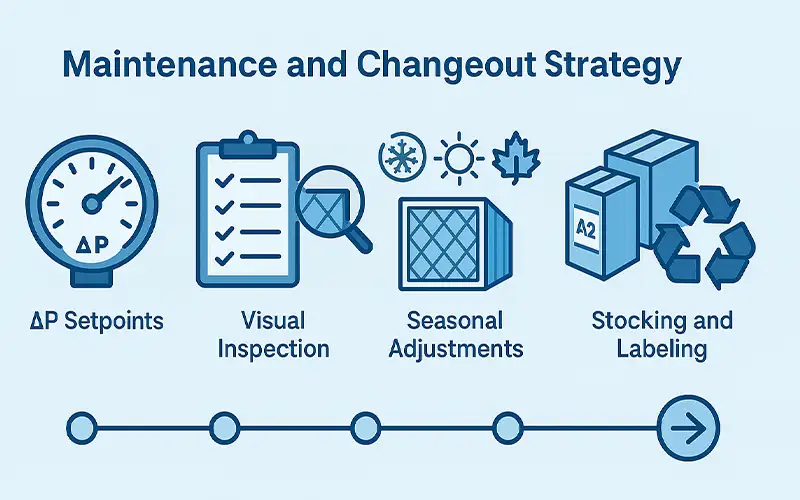
A reliable program combines pressure monitoring, quick visual checks, and a calendar tied to operating hours and seasons. The goal is to keep airflow stable and protect downstream filters without wasting life on early swaps.
ΔP setpoints
• Track filter pressure drop at a consistent face velocity.
• Establish a clean baseline after installation and log weekly (or via BMS trend).
• Set final ΔP where airflow and energy remain acceptable and before bypass risk; common ranges for panel prefilters are selected to protect fan headroom and downstream stages.
• Investigate sudden jumps in ΔP (possible blockage) or unusually slow rise (possible leaks/bypass).
Visual inspection
• Look for media tears, pleat collapse, wet spots, or frame warping.
• Check for gasket contact and signs of bypass dust downstream.
• Verify airflow arrows and consistent seating after service.
Seasonal adjustments
• Increase inspection frequency during pollen, construction, or peak-production periods.
• In cold months, loading may slow in some facilities; in spring/summer, outdoor and process dust may accelerate changeouts.
• Reconfirm setpoints when fan speeds or economizer strategies change.
Stocking and labeling
• Standardize SKUs by size, rating, frame, and pleat count; keep a par level based on average monthly usage plus a safety buffer for surges.
• Use color-coded shelf labels and on-filter stickers with install date, target final ΔP, and technician initials.
• Maintain a simple CMMS/BMS log: install date, ΔP baseline, notes on condition, and projected change date.
Disposal and recycling
• Bag used filters immediately to prevent dust release; follow site PPE and handling rules.
• Where allowed, separate metal or plastic frames for recycling; dispose of loaded media per local regulations.
• Record changeout weights or counts to track waste reduction from optimized intervals.
Quick cadence guide
• New install: record clean ΔP, confirm seal.
• Weekly or biweekly: log ΔP and do a 30-second visual check.
• At 80–90% of final ΔP: stage replacements and verify stock.
• At final ΔP or earlier if damaged/wet: change, reseal, and reset the baseline.
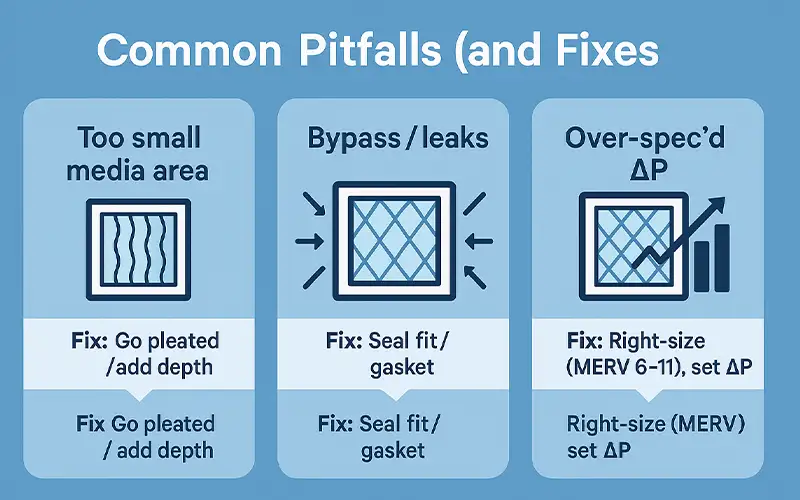
Panel filters fail most often due to sizing, sealing, or chasing the wrong efficiency. Use these checks to prevent wasted energy, premature changeouts, and downstream contamination.
Problem
Too little media area forces higher face velocity through the filter, driving up initial pressure drop, accelerating loading, and shortening life. It can also increase fiber shedding and risk pleat collapse.
Fix
• Move from flat pads to pleated panels of the same face size.
• Increase pleat count or step up to a deeper frame (2–4 in) where housings allow.
• Keep nominal face velocity within the datasheet’s tested range; overspeeding is a frequent cause of rapid ΔP rise.
Problem
Air takes the path of least resistance. Gaps at the frame or poor gasket contact let unfiltered air slip around the media, fouling coils and loading downstream filters despite “good” ratings.
Fix
• Verify the filter sits square in the track; use the correct thickness and exact dimensions.
• Add or replace gaskets; confirm even knife-edge contact where applicable.
• Inspect for warped frames, bent rails, and missing clips; repair housings to close gaps.
• After changeout, perform a quick dust smear or white-towel check downstream to confirm seal integrity.
Problem
Selecting a very high efficiency for a prefilter stage (or using a fine final filter as a prefilter) raises resistance, cuts fan headroom, and can reduce airflow below design. The result is higher energy per cfm and faster load on downstream stages due to disturbed system balance.
Fix
• Right-size efficiency to duty: for prefiltration, target coarse capture (for example MERV 6–11 or ISO ePM10) unless a risk assessment requires finer control.
• Compare options at your actual face velocity: pick the lowest initial ΔP that delivers the required coarse-particle removal.
• Set realistic final ΔP setpoints aligned with the fan curve; avoid “run to failure” that forces fans into inefficient regions.
• If finer control is needed, add a secondary stage designed for that purpose rather than pushing the prefilter beyond its role.
• ΔP rises too fast: media area too small, velocity too high, or unexpected dust load.
• Dust downstream despite frequent changes: sealing/bypass issue.
• Energy up, airflow down after a filter swap: efficiency overspec or mismatched velocity vs datasheet.
• Filters deforming: insufficient backing, excessive velocity, or moisture exposure.


Leave a comment