
Expert Support
Available 24/7 via chat
Available 24/7 via chat

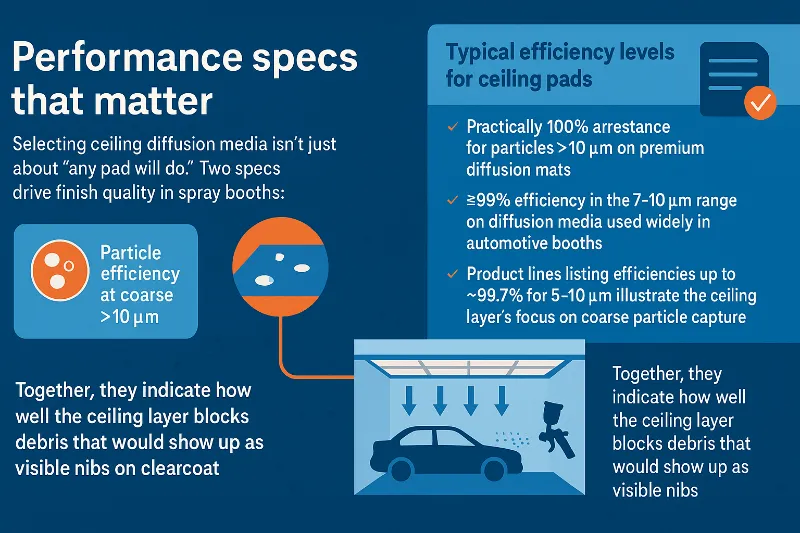
Selecting ceiling diffusion media isn’t just about “any pad will do.” Two specs drive finish quality in spray booths: particle efficiency at coarse sizes (≈10 μm) and the filter’s tested rating system (MERV/EN 779/ISO 16890). Together, they indicate how well the ceiling layer blocks debris that would show up as visible nibs on clearcoat.
Many diffusion blankets and panels are engineered to remove essentially all coarse contaminants that cause visible defects. Representative specs include:
Practically 100% arrestance for particles larger than 10 μm on premium diffusion mats such as Viledon PA/560 G-10, marketed specifically to prevent visually perceptible surface imperfections.
≥99% efficiency in the 7–10 μm range on diffusion media used widely in automotive booths.
Product lines listing efficiencies up to ~99.7% for 5–10 μm illustrate the ceiling layer’s focus on coarse particle capture at supply air.
These coarse-size efficiencies matter because particles around 10 μm and above are large enough to form visible high spots in wet paint; stopping them at the ceiling dramatically reduces dirt nibs.
Industry guidance for booth filtration emphasizes maintaining an internal atmosphere that removes >99% of ≥10 μm particulates from intake air.
Ceiling media is often labeled to one or more standards. Understanding each helps you compare options:
MERV (ASHRAE 52.2) reports minimum efficiency across three particle bands: 3.0–10 μm, 1.0–3.0 μm, and 0.3–1.0 μm. Higher MERV means better removal of smaller particles; ceiling media commonly falls around MERV 9–11 while still achieving ~99% capture in the 7–10 μm band.
EN 779 (legacy European) classes many ceiling blankets as M5/F5; product datasheets for diffusion media with ≥99% capture at 7–10 μm frequently reference this class.
ISO 16890 expresses efficiency as ePM classes tied to PM size fractions (ePM10, ePM2.5, ePM1). Ceiling diffusion media is often specified in the ePM10 range (e.g., ePM10 55%), aligning the spec with coarse particle control relevant to visible finish defects.
What these ratings mean for finish quality:
If the ceiling layer captures ≥99% of 7–10 μm particles and effectively conditions airflow, you significantly reduce dirt nibs and sanding/polishing rework because the particles most likely to print into clear are removed before they can enter the booth.
A higher MERV within the typical ceiling-media range can improve capture in the 3–10 μm band, but chasing very high MERVs isn’t the only lever; verify that the media is designed for diffusion duty at the ceiling, where even velocity distribution and low fiber migration are as critical as raw efficiency numbers.
Always read the datasheet for both efficiency and initial resistance (pressure drop). A ceiling pad with ~99% capture at 7–10 μm and moderate resistance at typical face velocities (e.g., 0.22 in. w.g. at 100 fpm for certain diffusion media) will protect finishes without starving the booth of uniform supply air.
Bottom line: for paint-booth ceilings, prioritize diffusion media with documented ≥99% capture around 10 μm, a rating scheme you understand (MERV/EN 779/ISO 16890), and airflow-conditioning design. Those specs directly translate to fewer visible nibs and more consistent top-coat quality.
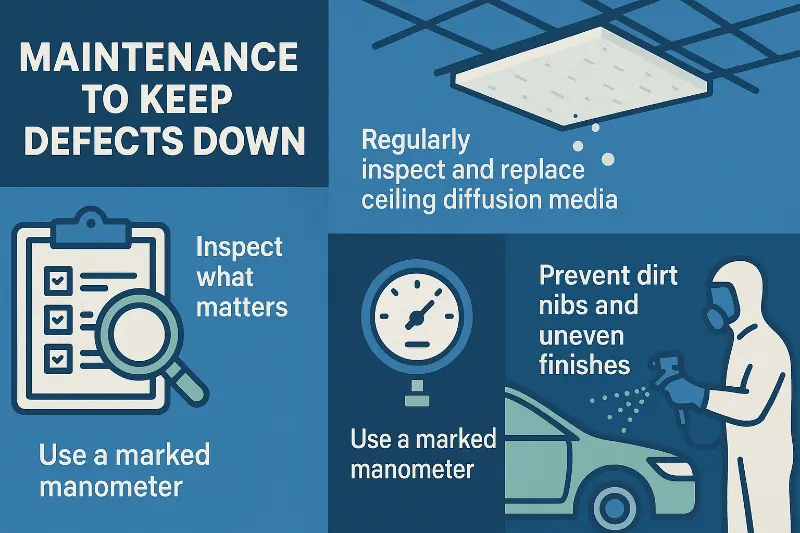
Regular inspection and timely replacement of ceiling diffusion media are essential to prevent dirt nibs and keep finishes consistent.
Manufacturer guidance stresses following the booth’s changeout schedule and using pressure gauges to trigger service rather than waiting for visible problems.
Check the ceiling intake layer weekly for:
discoloration, paint loading, or dark streaks indicating uneven capture
sagging, loose edges, or gaps that can cause bypass
debris buildup on grids and seals
rising differential pressure on the manometer/magnehelic compared with your clean baseline
NAFA recommends keeping pressure taps and tubing in good condition so readings remain reliable.
Intervals depend on volume, coatings, and ambient air quality, so pair visual checks with instrumentation:
many shops replace ceiling intake media at least twice per year; some schedules extend to roughly annual swaps in lighter-duty environments
exhaust media typically needs much more frequent changes (e.g., around 100 operating hours) and should not be used to infer intake life
set your intake change point by pressure drop or when face velocity can no longer be held to spec
GFS and Filtration Group Finishing both recommend using a marked manometer to decide when filters have reached the allowable pressure drop or when airflow falls below about 100 fpm at the booth face.
If you see any of the following, plan an immediate change:
uneven paint application, more dirt nibs, or extra polishing/rework
measurable drop in airflow/face velocity, fans running harder, or higher static pressure
visible darkening or patchy loading across the ceiling panels/blankets
These symptoms are common indicators listed by suppliers and maintenance guides.
As diffusion media loads with dust and overspray:
pressure drop rises, starving the system; axial/tube-axial fans lose capacity quickly as static increases, making it difficult to hold target fpm
airflow uniformity degrades; instead of smooth, evenly distributed supply, you get velocity “hot spots” and dead zones that recirculate fallout onto wet surfaces
fiber integrity can decline; without proper tackifier and scrim, particle migration risk increases
Use fan curves and your booth’s pressure budget to ensure the fan has headroom, and replace media before flow uniformity is compromised.
baseline and log clean-filter pressure drop and face velocity after each change
inspect weekly; record pressure and a quick visual of color/loading across the grid
replace when pressure reaches the marked limit or velocity falls below spec, even if the calendar interval hasn’t elapsed
verify seals, overlaps, and scrim orientation during install; GFS service manuals note replacing intake filters whenever inspection or performance indicates they’re due, not just by time alone.
Keeping intake media clean, sealed, and within its pressure window preserves uniform supply air—and that directly translates to fewer nibs and less rework.
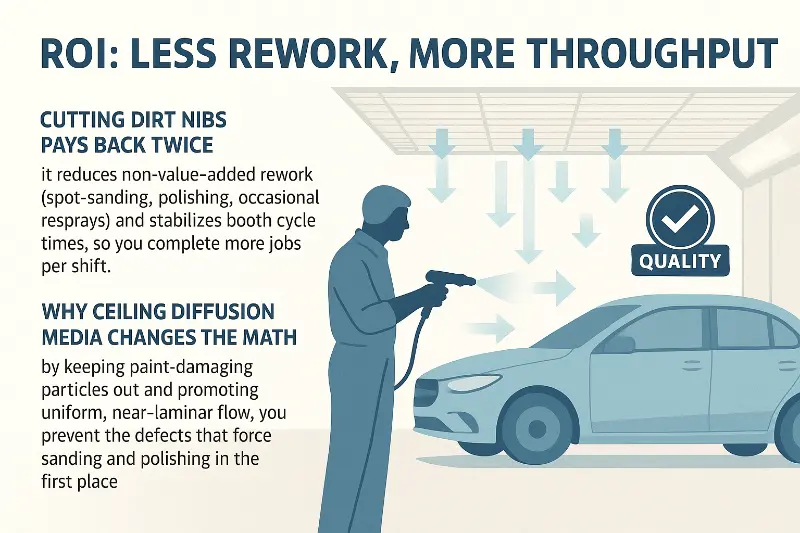
Cutting dirt nibs pays back twice: it reduces non-value-added rework (spot-sanding, polishing, occasional resprays) and stabilizes booth cycle times, so you complete more jobs per shift.
Each nib that cures into the clear typically triggers a defect-repair loop—mask off, denib, polish, inspect—with added consumables and booth/tech time. Industry repair workflows from finishing vendors show dedicated denib and polish steps specifically to fix dirt inclusions, confirming the extra labor baked into post-paint corrections.
When you consider prevailing refinish labor rates, that loop gets expensive fast. Many shops quote refinish/body rates in the roughly $50–$150+ per hour range (and higher in some markets), so shaving even 10–20 minutes of defect repair per panel compounds across a day’s schedule.
Ceiling diffusion media acts as the last intake stage to both stop incoming particulates and even out the supply airstream—two root causes of nibs. By keeping paint-damaging particles out and promoting uniform, near-laminar flow, you prevent the defects that force sanding and polishing in the first place. RoboVent+1
Refinish training and technical guidance consistently tie cleaner booths and proper filtration to fewer dirt inclusions, reinforcing that prevention beats repair on cost and quality. I-CAR+2I-CAR+2
Defect-driven rework injects variability into the booth schedule—a few “quick” denibs can cascade into late deliveries. Collision industry KPI guidance highlights cycle time as a core performance metric; reducing unplanned touch-ups helps you hit predictable durations and book more jobs with confidence. JTAPE+1
A stable, clean airstream from the ceiling media reduces velocity hot spots and contamination recirculation, which lowers the chance of redo work that ties up the booth and downstream detailing.
Preventing nibs upstream—via ceiling diffusion media and booth cleanliness—avoids high-rate labor spent on denib/polish cycles and protects schedule reliability. The result is fewer consumables, less technician rework, and more finished units per booth day.


Leave a comment