
Expert Support
Available 24/7 via chat
Available 24/7 via chat

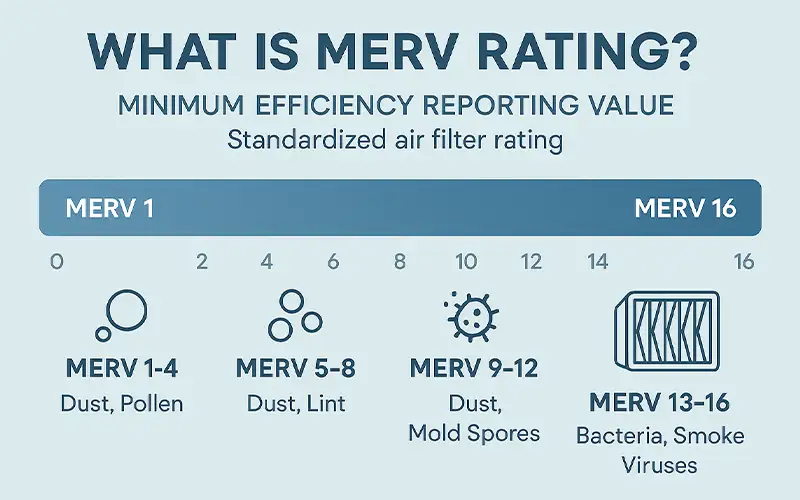
The Minimum Efficiency Reporting Value (MERV) is a standardized scale created by the American Society of Heating, Refrigerating and Air-Conditioning Engineers (ASHRAE). It measures the effectiveness of air filters in capturing airborne particles of varying sizes. The rating ranges from 1 to 16, with higher values indicating greater efficiency.
MERV 1–4: Capture large particles like dust, pollen, and carpet fibers. Commonly used in residential systems but unsuitable for sensitive environments.
MERV 5–8: Trap smaller particles such as mold spores and fine dust. These are standard for light commercial and some residential HVAC systems.
MERV 9–12: Provide higher efficiency, capturing fine particles including some bacteria and smoke. Suitable for healthcare offices and higher-demand facilities.
MERV 13–16: Capture particles as small as 0.3 microns, including allergens, bacteria, and finer dust. These levels are recommended for hospitals, laboratories, and data centers requiring stringent air quality.
More details on MERV classifications can be found in the official ASHRAE guidelines.
For data centers, MERV ratings are critical because air quality directly affects cooling efficiency and hardware reliability. Dust and fine particles can accumulate on servers, obstruct airflow, and increase cooling demands. This raises energy costs and risks overheating or hardware failures.
ASHRAE recommends filters rated at least MERV 8–11 for standard data centers, while MERV 13 or higher is advised in areas with significant particulate loads or stricter operational standards. Selecting the right filter helps balance airflow resistance with particle capture efficiency, ensuring servers remain clean while cooling systems operate efficiently.
The U.S. Environmental Protection Agency (EPA) also emphasizes that choosing appropriate filters improves indoor air quality and reduces strain on HVAC systems (EPA Indoor Air Quality).
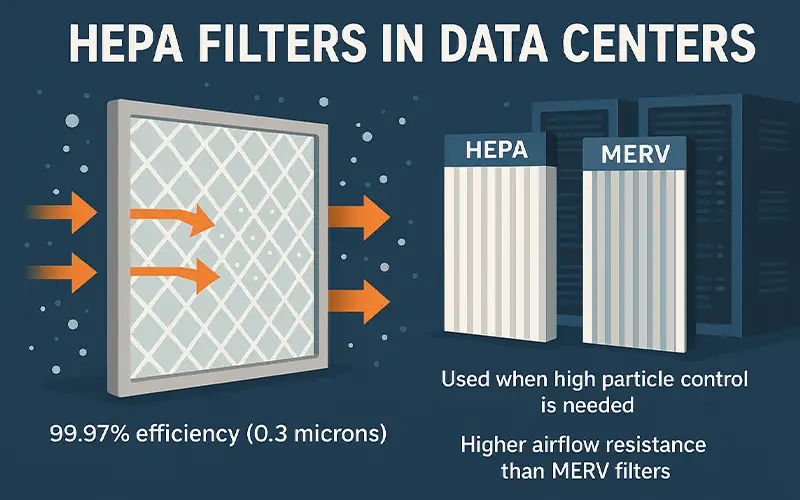
High-Efficiency Particulate Air (HEPA) filters are among the most efficient filtration options available. They are engineered to capture at least 99.97% of airborne particles as small as 0.3 microns, including fine dust, spores, and some bacteria. This level of efficiency makes HEPA filters a benchmark in environments where air purity is critical.
HEPA filters work by combining mechanisms such as interception, impaction, and diffusion to remove ultrafine particles. Their ability to capture contaminants far smaller than those typically addressed by MERV-rated filters ensures exceptionally clean air.
For data centers, this can mean reduced risk of dust buildup on sensitive hardware and extended equipment lifespan. More technical details on HEPA standards are available from the U.S. Environmental Protection Agency (EPA).
In most standard data centers, MERV 13–16 filters are sufficient. They provide an effective balance between particle capture and airflow resistance, which is essential for maintaining cooling efficiency. These filters remove the majority of dust and particulates that could compromise server performance without overloading HVAC systems.
HEPA filters are typically required only in mission-critical environments, such as:
Data centers handling healthcare records or pharmaceutical applications
Semiconductor or cleanroom-adjacent facilities with extremely low tolerance for contamination
Facilities located in regions with high levels of particulate pollution
However, HEPA filters also introduce significantly higher airflow resistance, which can strain HVAC systems and increase energy consumption if the system is not designed for them. That is why organizations such as ASHRAE recommend carefully evaluating the trade-off between air cleanliness requirements and system performance before upgrading to HEPA.
For many operators, HEPA is unnecessary unless strict regulations or environmental conditions demand it. In most cases, well-selected MERV filters provide a reliable and cost-effective solution.
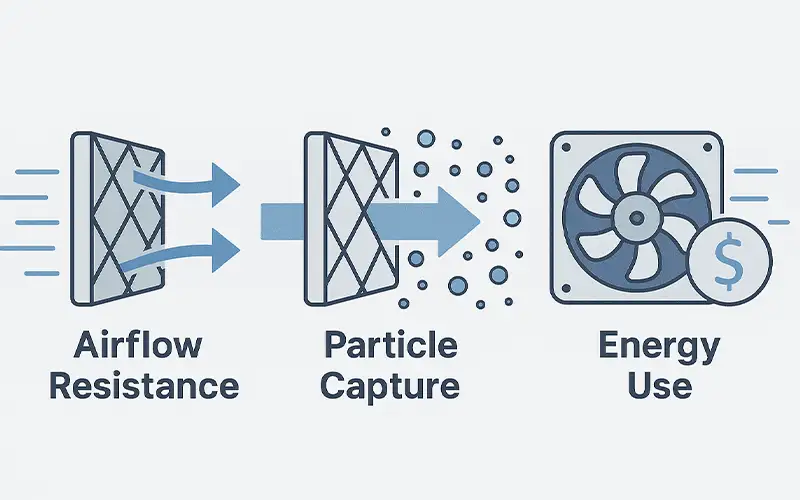
Air filtration in data centers requires a balance between capturing harmful airborne particles and maintaining efficient airflow.
Higher efficiency filters, such as MERV 15–16 or HEPA, capture more contaminants but also increase airflow resistance. This resistance can restrict the movement of cooled air, forcing HVAC fans to work harder to maintain the required airflow and temperature levels.
As a result, while cleaner air reduces equipment contamination, it may also create operational challenges if the system is not designed to handle the added resistance.
Filter selection directly influences data center energy consumption. High-resistance filters lead to greater fan energy use and may increase overall cooling costs.
Conversely, filters with lower resistance, such as MERV 13–14, often provide a more efficient balance by capturing sufficient particulate matter while minimizing system strain.
For data center operators, the goal is to select filters that both protect equipment and keep cooling systems efficient. Regular monitoring of pressure drop, along with an evaluation of local air quality conditions, helps determine the most effective filtration strategy.
By optimizing filter choice, facilities can safeguard servers, maintain uptime, and reduce unnecessary energy expenses.
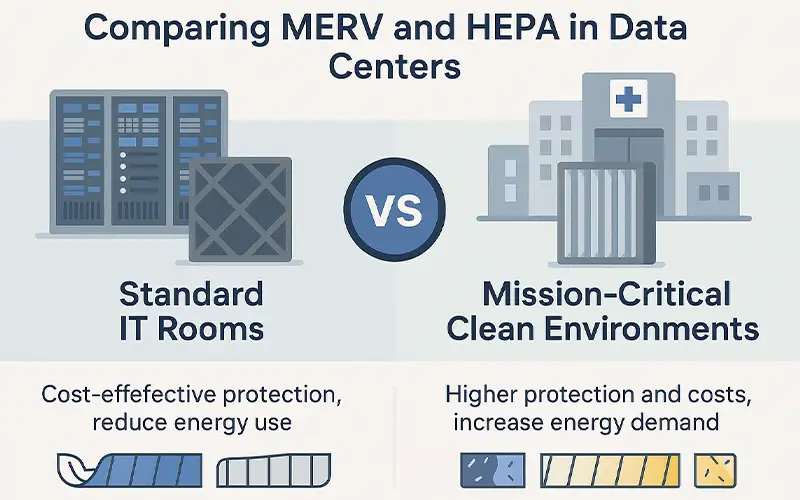
In most standard IT rooms, MERV-rated filters between 11 and 14 are sufficient to protect sensitive servers and maintain proper airflow. These filters effectively capture dust, pollen, and fine particles without significantly increasing resistance in the HVAC system.
On the other hand, mission-critical environments such as healthcare data centers, financial institutions, or facilities handling government data may require the superior performance of HEPA filters.
HEPA filtration ensures that nearly all harmful particles are removed from the air, creating an ultra-clean environment where even minor contamination could threaten operations.
MERV filters generally offer a cost-effective balance of protection and airflow efficiency. They are less expensive upfront, easier to replace, and typically require less energy to maintain airflow through the system.
HEPA filters, while providing near-total particle capture, come with higher costs in both equipment and energy use. Their increased resistance often requires stronger fans and more frequent monitoring of pressure drop, adding to operational expenses.
Maintenance cycles also differ. MERV filters can be replaced every 3–6 months in most data centers, while HEPA filters may last longer but require strict inspection schedules to ensure performance is not compromised.
For most facilities, MERV filters provide the right mix of protection and efficiency. HEPA filters are reserved for cases where zero-tolerance for contamination justifies the higher costs and energy demands.
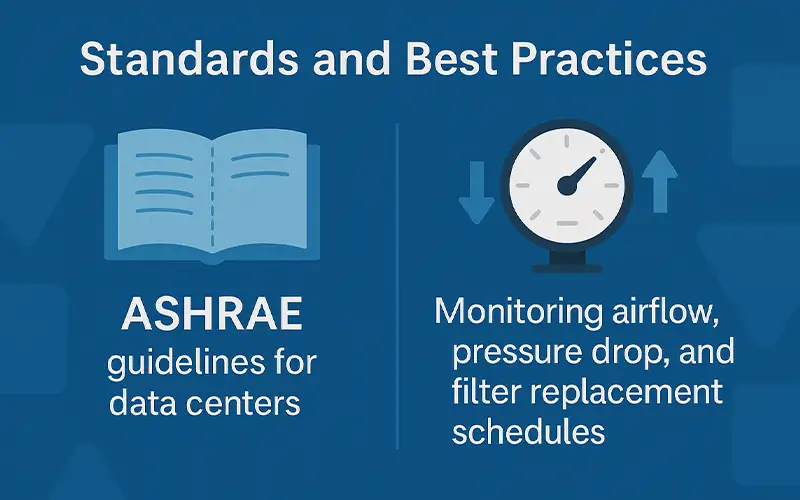
The American Society of Heating, Refrigerating and Air-Conditioning Engineers (ASHRAE) provides detailed recommendations for air filtration in data centers.
According to ASHRAE Technical Committee 9.9, filters with MERV ratings between 8 and 11 are generally recommended for most data center environments, as they balance efficiency with airflow requirements.
In areas with higher particulate loads or more sensitive equipment, filters with MERV 13 or higher may be specified. These guidelines emphasize that filtration should not compromise cooling efficiency, which is critical for maintaining safe operating temperatures for IT equipment.
Consistent monitoring of airflow and filter performance is essential in data centers. A gradual increase in pressure drop across filters indicates that they are loading with dust and particles, reducing HVAC efficiency.
Installing differential pressure gauges allows facility managers to track performance and replace filters before airflow is compromised.
Replacement schedules should be based on operational conditions rather than fixed intervals alone. High-pollution environments may require more frequent filter changes, while cleaner settings may allow longer service intervals.
Regular inspections, combined with ASHRAE’s recommended practices, ensure both air quality and energy efficiency are maintained without risking downtime or damage to sensitive IT infrastructure.


Leave a comment