Skip to content
Why Air Filtration Is Essential for the Photovoltaic Manufacturing Industry

Why Air Filtration Is Essential for the Photovoltaic Manufacturing Industry

Photovoltaic (PV) manufacturing depends on precision at the microscopic level—where even a tiny airborne particle or chemical vapor can reduce cell efficiency, create coating defects, or damage sensitive tools.

As production scales toward higher output and thinner films, air quality becomes a defining factor in yield, reliability, and operational cost.

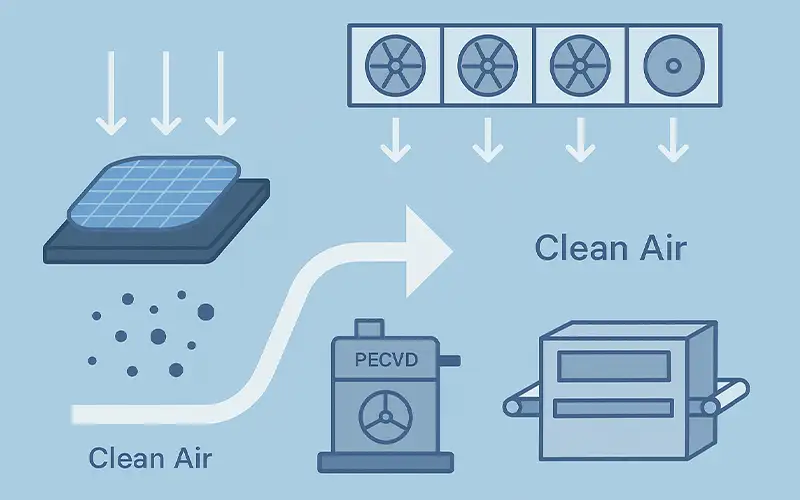
Air filtration plays a critical role in protecting wafers, coatings, and encapsulants from dust, mist, and volatile contaminants throughout the process—from wafer cutting and diffusion to lamination and module assembly.

This post explores how clean air supports solar cell performance, the types of filters required across PV production stages, and how advanced filtration systems help manufacturers achieve both higher yield and greener, energy-efficient operations.

Clean air — a critical factor in solar cell efficiency

Air purity directly impacts the performance and reliability of photovoltaic (PV) cells. Both crystalline silicon and thin-film solar technologies rely on precise surface and coating processes that can be disrupted by even trace levels of airborne contaminants.

How airborne dust, oil mist, and vapors affect PV processes

During wafer cutting, cell texturing, and thin-film deposition, particles and vapors suspended in the air can settle on substrates or coating chambers. Dust and oil aerosols cause pinholes, delamination, or uneven film thickness in PECVD and sputtering systems.

Residual vapors from lubricants, adhesives, or cleaning solvents can react with process gases, changing film chemistry or creating unwanted nucleation sites.

The U.S. Department of Energy notes that thin-film deposition quality depends heavily on the purity and stability of cleanroom airflow (DOE Solar Energy Technologies Office).

The link between air quality and conversion efficiency

Contamination introduces surface defects that reduce carrier mobility and light absorption.

A single micron-sized particle on a solar wafer can shadow hundreds of microcells or interrupt conductive layers, cutting electrical output. In thin-film lines, dust on transparent conductive oxide (TCO) or absorber layers leads to voids, localized heating, and lower fill factors.

Maintaining ISO 7–8 cleanroom conditions in module assembly helps preserve uniformity and electrical performance across large-area panels.

Why even submicron particles matter

Particles smaller than 1 µm are particularly damaging because they stay airborne longer and easily penetrate conventional HVAC filters. Once deposited, they are difficult to remove without scratching or damaging delicate surfaces.

Submicron contamination can also cause micro-arcing or insulation failures in metallization lines.

Cleanroom standards such as ISO 14644-1 define maximum allowable particle concentrations to prevent these issues, ensuring that every step of PV manufacturing—from wafer prep to final lamination—occurs in air clean enough to protect the cell’s conversion efficiency and long-term reliability.

Why Air Filtration Matters in Photovoltaic Manufacturing

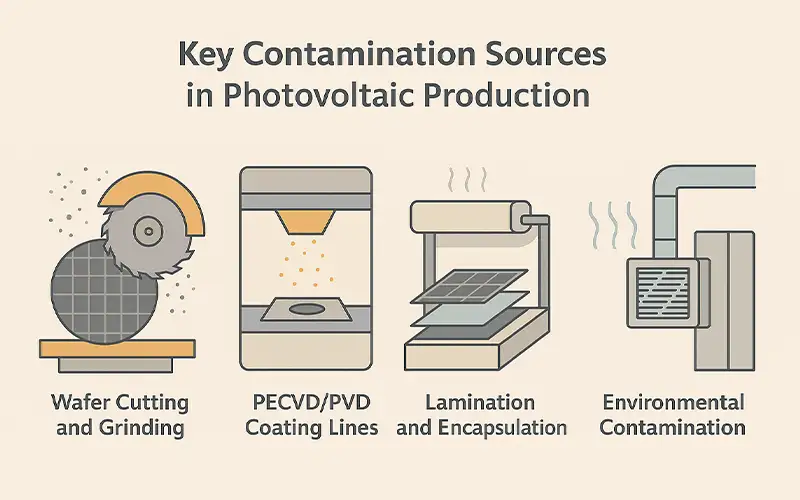
Key contamination sources in photovoltaic production

Airborne and process-generated contaminants appear at multiple points along the PV line. Identifying where they arise helps set the right filtration and housekeeping controls.

Wafer cutting and grinding: silica dust and coolant mist

Wire sawing and edge grinding release fine silica and kerf particles that stay airborne or redeposit on wafers, along with aerosolized coolant/abrasive slurry.

These particles scratch surfaces, seed defects in texturing, and prematurely load downstream filters. Use source capture at saws, coalescing prefilters for mist, and staged prefilter → medium filter chains on recirculated air.

PECVD/PVD coating lines: metallic vapors and fine particulates

Thin-film steps (e.g., TCO, anti-reflection, or absorber layers) generate metallic vapors and ultrafine particulates that can backstream into chambers and settle on substrates, causing pinholes, roughness, and non-uniform thickness.

Terminal HEPA/ULPA filtration over load/unload, plus periodic chamber clean and dedicated exhaust filtration, reduces redeposition.

See background on PV deposition and manufacturing from the U.S. Department of Energy’s Solar Energy Technologies Office: DOE SETO.

Lamination and encapsulation: silicone outgassing and VOCs

During lamination, encapsulants and sealants (e.g., EVA, silicone) can outgas organics that haze glass, poison coatings, or leave residues that weaken adhesion.

Molecular filtration (activated carbon or impregnated alumina) upstream of sensitive zones captures VOCs and siloxanes.

For general information on VOC control in indoor air, refer to the U.S. EPA overview: EPA – Volatile Organic Compounds.

Environmental contamination from HVAC leaks or maintenance activity

Gasket leaks, poorly sealed penetrations, or imbalanced pressure cascades can draw unfiltered air into clean areas. Maintenance—opening panels, exchanging tools—often re-entrains settled dust.

Validate rooms to ISO 14644 classes and recheck after interventions; maintain positive pressure in clean zones, verify filter seals, and perform smoke/particle recovery tests. Classification limits are defined in ISO 14644-1.

Why Air Filtration Matters in Photovoltaic Manufacturing

How air filtration protects products and equipment

Effective PV manufacturing relies on clean, stable airflow that removes particles and harmful vapors before they reach sensitive surfaces or equipment.

A risk-based filtration stack and disciplined monitoring keep deposition, bonding, and inspection steps within specification while controlling operating cost.

Multi-stage filtration design

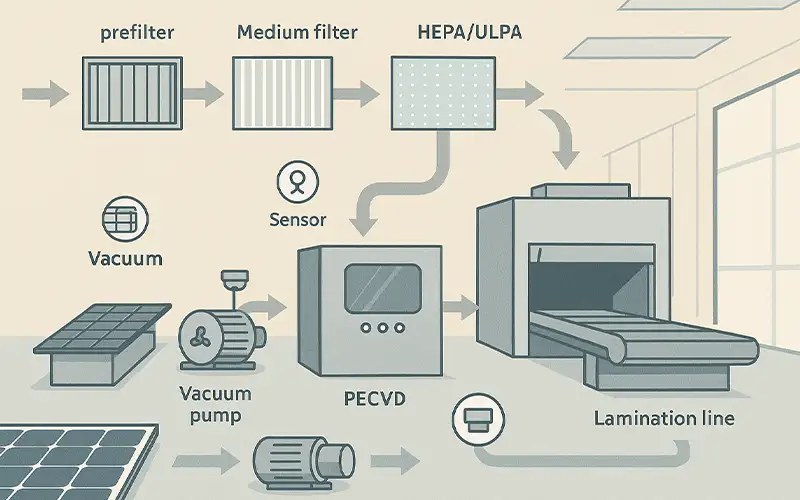
Start with prefilters to intercept large dust and coolant droplets, followed by medium-efficiency stages to stabilize airflow and extend final-filter life.

Use HEPA or ULPA terminals near load/unload, inspection, and assembly to hold ISO 7–8 conditions. Add molecular filtration (activated carbon or impregnated alumina) anywhere VOCs or siloxanes can haze glass, poison coatings, or drift into metrology optics.

Cleanroom classification principles and particle limits are defined in ISO 14644-1: ISO 14644-1 cleanroom standard.

Preventing defects in deposition and bonding zones

In PECVD/PVD areas, submicron particles create pinholes, roughness, and thickness nonuniformity; in lamination and encapsulation, vapors leave films that weaken adhesion or reduce optical transmission.

Terminal HEPA/ULPA modules over critical paths, combined with directional flow and pressure cascades, sweep contaminants away from substrates and bonding interfaces, improving film quality and module reliability.

Background on PV manufacturing processes is available from the U.S. Department of Energy’s Solar Energy Technologies Office: DOE SETO.

Extending lifetime of vacuum pumps, sensors, and optical systems

Cleaner supply air reduces particulate load on chamber walls and forelines, lowering pump oil degradation and seal wear.

Molecular filters protect mass-flow controllers, spectroscopic sensors, and vision systems from fouling or drift.

Keeping optics and TCO/AR-coating equipment free of deposits maintains calibration, reduces unplanned cleans, and preserves tool uptime.

Reducing rework, downtime, and yield loss

Stable, low-ΔP filtration helps maintain target face velocities and recovery times, which shortens post-maintenance restart and lowers scrap after excursions.

With fewer pinholes and bonding defects, downstream rework falls, cycle times tighten, and die-per-panel (or cells-per-lot) yield improves.

Monitoring differential pressure and particle counts against qualification baselines enables condition-based changeouts—preventing both early replacements and late-stage clogging that can trigger tool alarms and unplanned downtime.

Why Air Filtration Matters in Photovoltaic Manufacturing

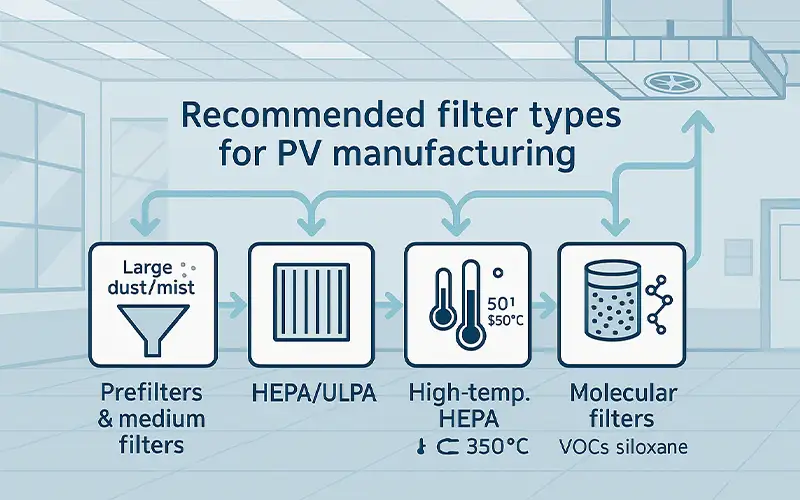
Recommended filter types for PV manufacturing

Selecting the right filtration stack keeps crystalline and thin-film lines stable, protects tools, and preserves conversion efficiency.

The goal is to meet ISO 7–8 conditions at key stations while controlling energy and lifecycle cost. For particle class limits and testing concepts, see ISO 14644-1 cleanroom guidance: ISO 14644-1.

Prefilters and medium filters: trap large dust and mist particles

Install coarse and medium-efficiency stages upstream of finals to capture kerf dust from wafering and aerosolized coolant from grinding.

High-capacity pleated or pocket filters smooth airflow, protect HEPA/ULPA media from premature loading, and keep pressure drop predictable between changeouts.

HEPA/ULPA filters: ensure ISO 7–8 cleanroom conditions

Use terminal HEPA (H13/H14) or ULPA modules at load/unload, inspection, and assembly zones to maintain low particle counts across substrates and optics.

Gel-seal or knife-edge frames prevent bypass, while scan-testable plenums and upstream ports support in-situ leak testing required for qualification and routine requalification per cleanroom standards.

High-temperature filters: withstand 250–350 °C in diffusion and annealing lines

For furnaces, firing, and depyrogenation-like steps, specify glass-fiber high-temperature HEPA elements with stainless frames and heat-stable sealants.

These designs resist fiber embrittlement and seal creep during heat-up/hold/cool-down cycles, preserving cleanliness in hot zones.

Molecular filters (activated carbon/alumina): remove VOCs and siloxanes

Encapsulants, adhesives, and silicone materials can outgas organics and siloxanes that haze glass or interfere with coatings.

Activated carbon and impregnated alumina beds capture VOCs and reactive vapors upstream of deposition and lamination areas.

For general VOC context, see the U.S. EPA overview: EPA – Volatile Organic Compounds.

Fan filter units (FFUs): maintain laminar airflow in coating and inspection areas

A dense, balanced grid of FFUs delivers uniform, downward flow over critical paths, sweeping particles away from substrates and minimizing crossflow between stations.

Pair FFUs with pressure cascades and well-placed returns to control directionality, reduce re-entrainment, and speed recovery to class after interventions.

Why Air Filtration Matters in Photovoltaic Manufacturing

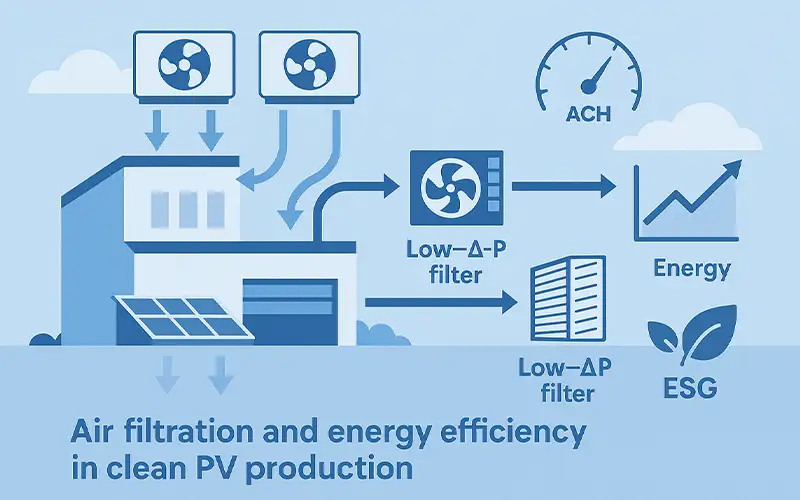
Air filtration and energy efficiency in clean PV production

Energy consumption in photovoltaic (PV) cleanrooms is largely driven by the fans that move air through filters.

Optimizing filter resistance and airflow strategy allows manufacturers to maintain required ISO cleanliness while cutting operational costs and carbon footprint.

The role of low-ΔP filters in reducing fan energy use

Each additional pascal of pressure drop adds to fan power consumption. Selecting low-ΔP filters with high dust-holding capacity and changing them based on condition rather than fixed intervals reduces static pressure and stabilizes flow.

This approach aligns with the U.S. Department of Energy’s recommendations for efficient fan systems in the DOE Better Buildings fan efficiency guide.

Combining variable-speed drives (VSDs) with low-resistance media can cut fan energy use by up to 30% without affecting air quality.

Optimizing air-change rates for cost and sustainability

Air-change rates (ACH) should be based on qualification and real-time monitoring instead of default design rules.

Many ISO 7–8 rooms can operate safely at lower ACH during steady-state operation, increasing rates only during high-activity or maintenance periods. This dynamic control reduces fan load and extends filter life.

The ISO 14644-2 standard provides a framework for monitoring and demonstrating continued cleanroom performance, supporting risk-based airflow adjustments that maintain compliance and reduce waste.

Aligning filtration strategy with green manufacturing goals

Filtration design is a key part of sustainable cleanroom engineering. By integrating smooth duct paths, well-balanced FFU grids, and continuous differential-pressure tracking, facilities can minimize system losses and maintain efficiency across the filter lifecycle.

Energy standards such as ASHRAE 90.1 highlight filtration’s contribution to total fan power and encourage specifying low-pressure-drop media to meet efficiency and emissions goals.

In practice, optimized air filtration supports both higher yield and cleaner, greener solar production.

Why Air Filtration Matters in Photovoltaic Manufacturing

CleanLink filtration solutions for photovoltaic factories

CleanLink delivers a full filtration stack tailored to PV lines, from wafering and PECVD/PVD to lamination and final inspection.

Systems are engineered around low-ΔP media, leak-tight housings, and scan-test access to maintain ISO cleanroom performance throughout the factory.

Custom HEPA/ULPA modules for coating and cell assembly

Gel-seal or knife-edge terminal modules provide uniform, downward flow over load/unload, inspection, and stringing/tabbing stations.

Options include H13/H14 HEPA or U15 ULPA media, with upstream ports for in-situ scan testing and plenum designs that hold velocity uniformity over large areas.

High-temperature HEPA for diffusion and firing furnaces

Glass-fiber high-temperature HEPA elements with stainless frames and heat-stable sealants withstand 250–350 °C duty.

Rigid construction prevents seal creep through heat-up/hold/cool-down cycles, keeping hot zones clean and reducing furnace maintenance.

AMC control units for VOC and siloxane removal

Modular beds using activated carbon and impregnated alumina capture organics and siloxanes from encapsulants, adhesives, and silicone materials—protecting optics, TCO layers, and sensor accuracy in nearby processes.

Maintenance support: ΔP monitoring, filter integrity testing, and lifecycle tracking

Integrated pressure taps and sensors trend differential pressure at each stage, enabling condition-based changeouts. Scan-testable frames and upstream ports speed integrity testing after maintenance.

CleanLink’s service plans document ΔP, particle recovery, and changeout history to support ongoing performance verification aligned with ISO 14644-2 monitoring principles.

Final Thoughts

Clean air is the foundation of reliable photovoltaic manufacturing. Effective filtration minimizes airborne dust, mist, and molecular contaminants that cause coating defects, adhesion failures, and tool downtime.

By maintaining stable ISO-class conditions, manufacturers protect both product quality and worker safety, ensuring each module performs to its designed efficiency.

Filtration as both a productivity and ESG advantage

A well-designed filtration system delivers more than cleanliness—it directly improves yield, uptime, and energy performance. Low-ΔP filters and optimized airflow lower fan power, extend media life, and reduce total energy demand, supporting sustainability and cost goals simultaneously.

Cleaner air also helps companies meet environmental, social, and governance (ESG) standards by lowering waste, emissions, and maintenance-related resource use.

In the drive toward greener energy, photovoltaic manufacturers that invest in advanced air filtration aren’t just protecting their cleanrooms—they’re reinforcing the entire clean energy value chain with greater reliability, efficiency, and environmental responsibility.

Previous article Air Filtration for Lithium Battery Production Safety
Next article How Air Filtration Safeguards Product Sterility in Pharma Cleanrooms

Leave a comment

* Required fields