
Expert Support
Available 24/7 via chat
Available 24/7 via chat

Since 2025, African Swine Fever (ASF) has emerged as a relentless and escalating threat across Southeast Asia, severely impacting the region’s pig farming industry and threatening both economic stability and food security.
Countries such as Vietnam, Thailand, and the Philippines have borne the brunt of this crisis, facing widespread outbreaks that have resulted in significant livestock losses and financial devastation.
With a near-100% mortality rate in pigs and no widely available effective vaccine, ASF’s highly contagious nature has made it exceptionally challenging to control.
In the Philippines, ASF has staged a troubling comeback since late 2024. According to a February 2025 report from the Philippine Star, the disease resurfaced in provinces like Bataan and South Davao, prompting the culling of approximately 5,000 pigs.
Agriculture Secretary Francisco Tiu highlighted the government’s efforts to counter the outbreak, stating that authorities are intensifying biosecurity measures and accelerating vaccine development trials.

Vietnam, a global leader in pork production, has faced an unrelenting wave of ASF outbreaks. A January 15, 2025, article in Vietnam News reported that the country recorded around 1,200 outbreaks in 2024, leading to the culling of over 100,000 pigs.
A February 2025 update from the World Organisation for Animal Health (WOAH) confirmed the detection of recombinant ASF virus strains (genotypes I and II) in Vietnam, signaling a complex evolution of the disease that threatens to undermine control measures.
In Thailand, fresh ASF outbreaks have added to the regional crisis. The Bangkok Post reported on February 20, 2025, that the disease struck Chiang Mai and Ratchaburi provinces in January, resulting in the culling of approximately 3,000 pigs.

The ASF crisis extends beyond Vietnam, Thailand, and the Philippines, affecting other Southeast Asian nations.
In Indonesia, a February 10, 2025, report from the Jakarta Post detailed an outbreak in a village in East Java, where 1,000 pigs were culled.
In Laos, a February 2025 report confirmed an outbreak in Xaysomboun province, with authorities designating it a red zone to limit further transmission.
Meanwhile, Malaysia faced a dire situation, as reported by Mothership.SG in February 2025: 76,000 pigs across 56 farms in Selangor tested positive for ASF. A phased culling plan was initiated, with the first batch of 1,868 infected pigs already disposed of.
The escalating ASF outbreaks pose a growing threat to Southeast Asia, with profound economic and social consequences. The region has lost billions of dollars due to mass culling, disrupted pork supply chains, and soaring prices.
Smallholder farmers, who rely heavily on pig farming for their livelihoods, are especially vulnerable, often facing financial ruin after a single outbreak.
A research found that ASF is becoming endemic in Asia, with the EMPRES-i database recording 4,836 notifications, including 3,074 domestic pig-related outbreaks and 1,762 wild boar cases.

Air filtration is a key strategy in controlling the spread of African Swine Fever (ASF), a devastating viral disease affecting pigs.
ASF virus can spread through aerosols, tiny particles suspended in the air, making it a significant concern in densely populated farming areas.
Research published in Frontiers in Veterinary Science demonstrates that ASF virus particles can remain viable in the air, traveling short distances and infecting pigs in nearby facilities.
This airborne pathway is especially problematic in regions with intensive pig farming, such as Southeast Asia, where farms are often located close together, increasing the risk of rapid disease spread.
In pig farms, air filtration systems effectively remove pathogens from the air, protecting pigs from diseases like African Swine Fever (ASF) through a series of physical and mechanical processes. The working principle involves the following steps:
The ventilation system first draws external air into the filtration unit. A pre-filter removes larger particles such as dust, hair, and insects, preventing them from clogging the subsequent high-efficiency filters.
The core component is the high-efficiency filter, such as HEPA filters or compact V-bank filters (e.g., Clean-Link’s Replaceable V-Bank Filter). These filters capture microscopic particles through the following mechanisms:
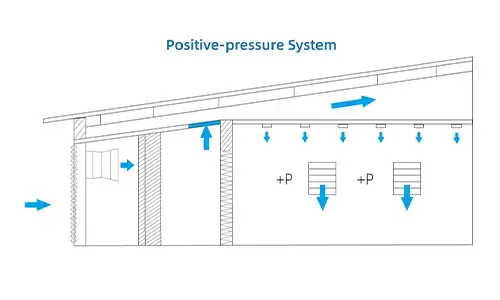
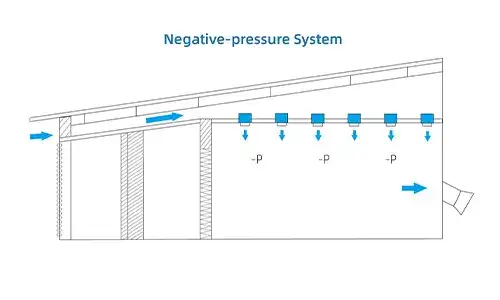
Filtered clean air is circulated into the pig housing via fans, maintaining a positive pressure environment to prevent unfiltered external air from entering.
This design is particularly important in Southeast Asia’s humid, high-temperature conditions, reducing the risk of airborne pathogen spread.
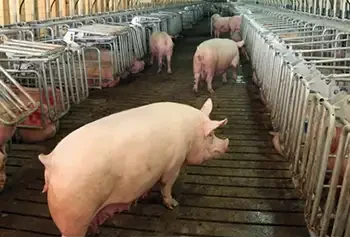
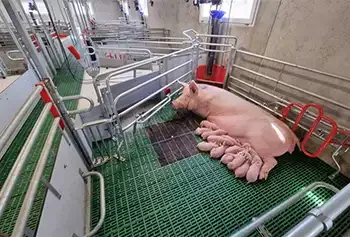
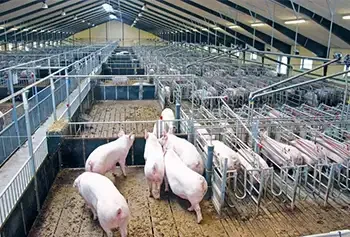
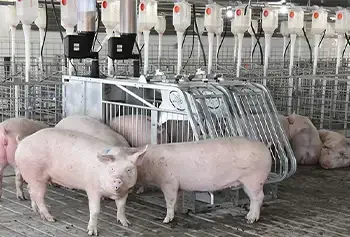
African Swine Fever (ASF) outbreaks deliver a devastating financial blow to pig farms, wiping out herds, halting production, and triggering cascading economic losses.
In Southeast Asia, the impact has been particularly severe.
Vietnam, for instance, saw nearly 6 million pigs—over 20% of its national herd—culled or killed by ASF within five months of its first outbreak in 2019, with economic losses estimated between $880 million and $4.4 billion in that year alone (Texas A&M NRI, 2024).
The Philippines has faced monthly losses of nearly $20 million due to ASF infections, with over 300,000 pigs culled by mid-2023 (Reuters, 2019; Frontiers, 2023).
Indonesia reported the death of over 3.5 million pigs across 10 provinces, while Thailand, though initially spared, faced trade disruptions and a looming threat costing an estimated $4 billion if ASF took hold (Frontiers, 2023; Animal Frontiers, 2020).
Globally, China’s ASF crisis slashed its pig population by 40%, with losses approaching $119 billion over a decade (Texas A&M NRI, 2024).
The Asian Development Bank estimates direct costs of ASF across Asia could range from $55 billion to $130 billion, disproportionately burdening smallholders (ADB, 2020).
These figures underscore a grim reality: ASF doesn’t just kill pigs—it decimates livelihoods, disrupts food security, and destabilizes rural economies.
For Southeast Asian farmers, the financial toll includes not only the loss of livestock but also skyrocketing feed costs, reduced market access due to trade bans, and the expense of culling and disposal.

Amid this crisis, air filtration emerges as a powerful, yet underutilized, tool to mitigate losses and deliver long-term savings.
Studies show that ASF can spread via aerosols, particularly in densely packed farms common in Southeast Asia (Frontiers, 2023).
By installing high-efficiency air filtration systems, farms can trap airborne pathogens before they infect herds, significantly reducing outbreak risks.
Research from the University of Minnesota highlights that advanced filtration systems, such as those with HEPA or compact V-bank designs, can capture up to 99.97% of particles as small as 0.3 microns—well within the size range of ASF-carrying aerosols (Swine Health Information Center, 2024).
A study on pig farms using air filtration in North America found a 50-70% reduction in disease incidence, translating to savings of $5 to $15 per pig in veterinary costs and lost productivity (Swine Health Information Center, 2024).
In energy terms, modern filtration systems designed for pig barns—like compact V-bank filters—optimize airflow while cutting ventilation costs by up to 20% through improved efficiency (FAO, 2022).
For a medium-sized Southeast Asian farm with 1,000 pigs, this could mean annual savings of $10,000-$20,000, offsetting the initial investment within 1-2 years.
In Vietnam’s Lao Cai province, where ASF costs reached $8.27 million in 2020, even a 30% reduction in outbreaks could have saved over $2.5 million—far exceeding filtration installation costs (PMC, 2022).
Air filtration not only protects revenue but also avoids the crushing expenses of culling, compensation delays, and market disruptions.
For Southeast Asian operators facing razor-thin margins, this technology offers a proactive, cost-effective shield against ASF’s economic carnage.


Leave a comment